
Gorreana Tea Factory: Opening Hours, Free Visit and Tasting
Visiting Chá Gorreana and tasting its tea is free and needs no booking: you walk through the rooms of a factory that has made tea since 1883 and where, according to the plantation, the original machinery can be seen at work (outside the harvest, from November to March, it is worth asking first).
By Ander BilbaoOwn photosPublished 9 min read
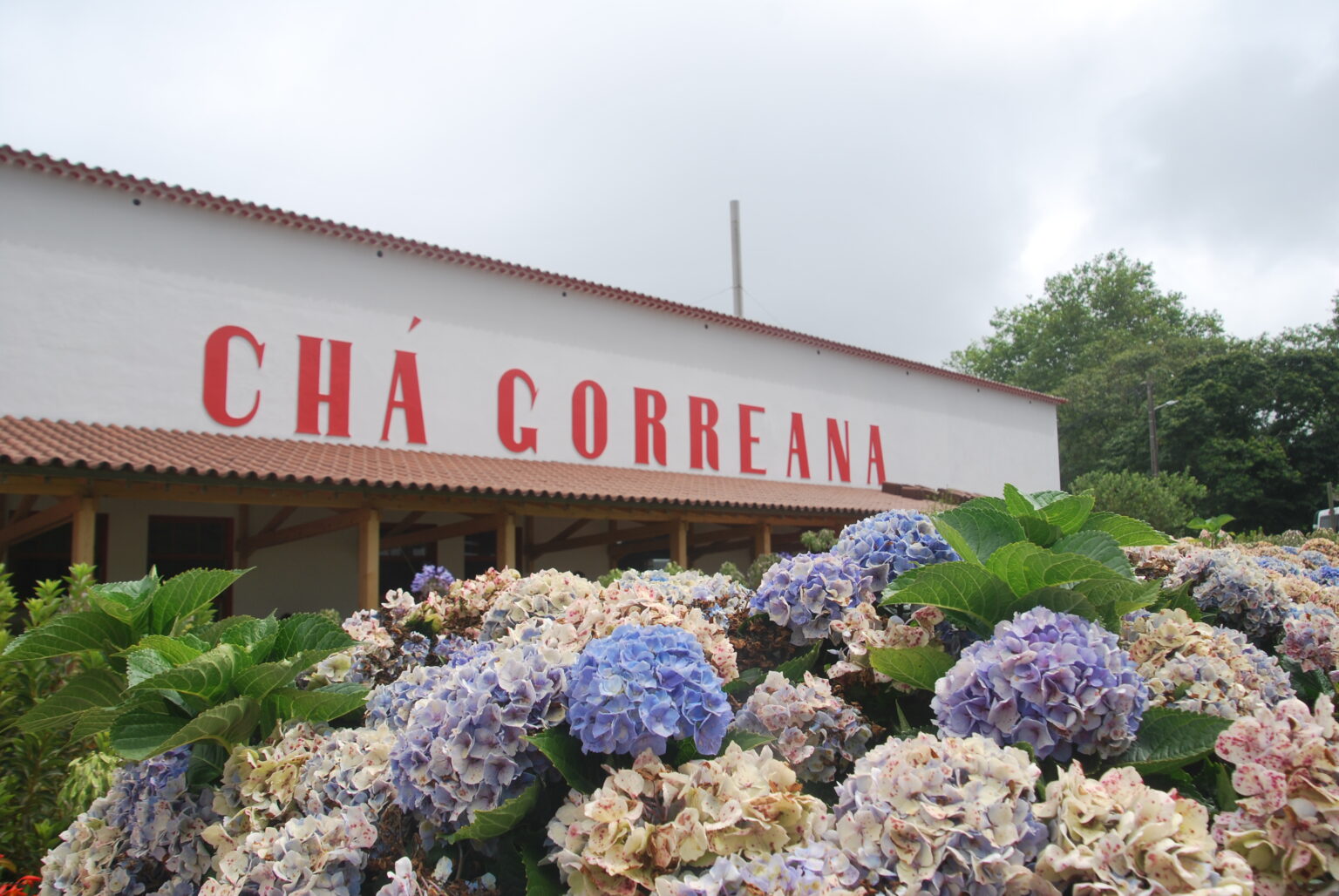
Chá Gorreana in short
- Price
- Visit and tasting, free
- Booking
- Not needed
- Hours
- Monday to Friday, 8:00–18:00; weekends, 9:00–18:00
- Time
- 1 hour; optional 30-minute guided tour
- Where
- Maia (Ribeira Grande), on the north coast of São Miguel
- By bus
- Lines 105 and 106 from Ponta Delgada: 51 to 58 min, on weekdays
Data checked on 15 Nov 2026 with: the Gorreana website (price, booking, hours and location), ERIH (visit time and guided tour) and the weekday timetable of the CRP bus company.
Photographs by the author, taken with a Nikon D60 and a Tamron 18-270 mm lens on 31 July 2023, according to their EXIF data. The facts come from the plantation’s website, the bus operator and the other sources listed at the end, with the source under each block. About me
| Section | The essentials |
|---|---|
| 01How the factory works | 8 rooms · original machinery |
| 02Tasting and the house teas | Free tasting · 4 loose-leaf teas, €2.98–€6.96 |
| 03A short history | Tea since 1883 |
| 04Soil, climate and growing | No herbicides · organic |
| 05Getting there | Buses 105 and 106 · car |
| 06Practical details | Contact · facilities · shipping |
| 07The PRC28 “Chá Gorreana” trail | 3.4 km · 1 h 30 · easy |
| ·Sources | |
How the factory works: the eight rooms on the tour
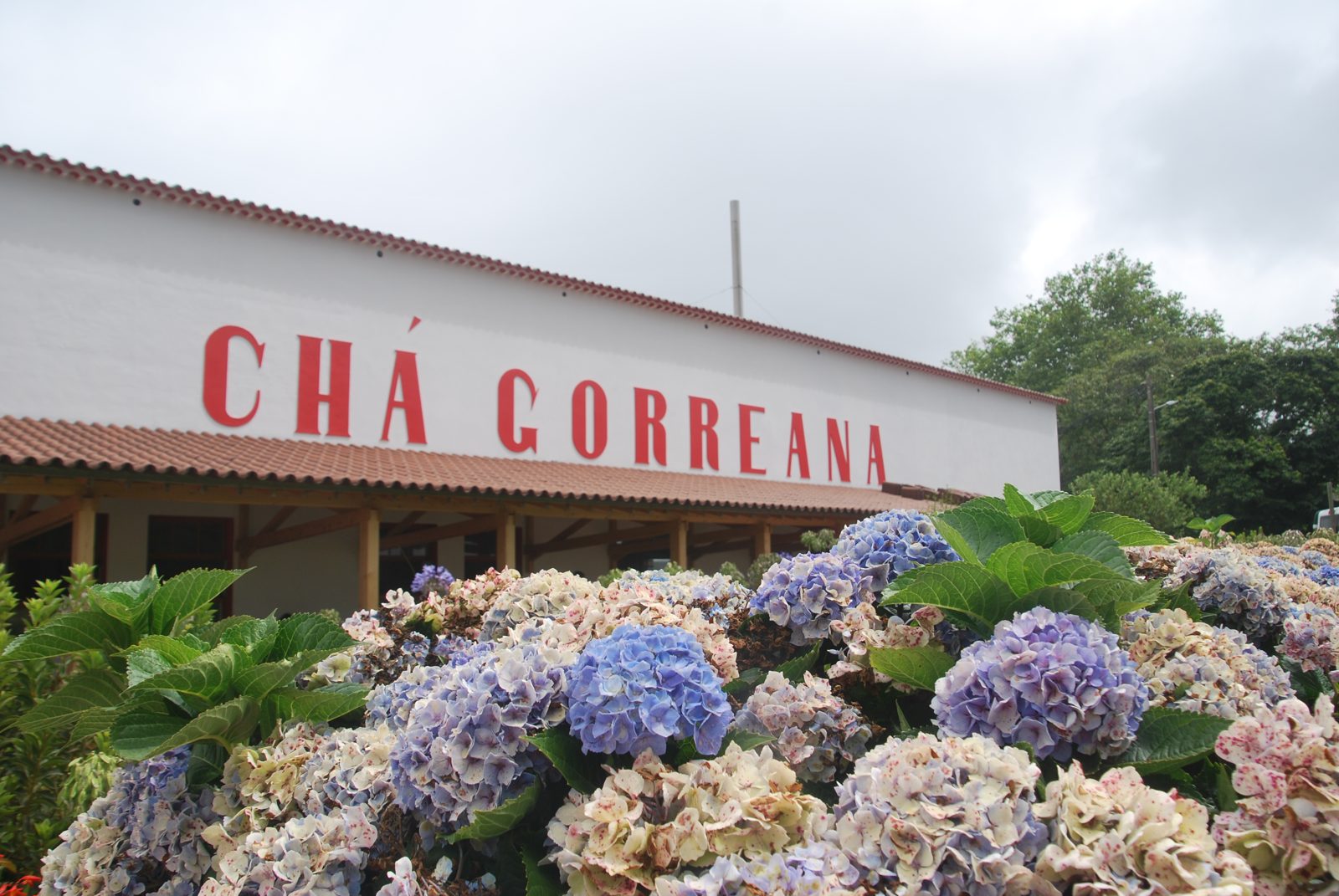
It is a working factory, and according to the plantation all the original machinery can be seen in operation. The main machines are British and date from the 19th and early 20th centuries. The plantations can be walked freely.
The harvest runs from April to October. The shoots are picked when they have three leaves, and that leaf is made into black, green or oolong tea, depending on the process. The website does not say whether the machines run outside the harvest: between November and March, ask before you go.
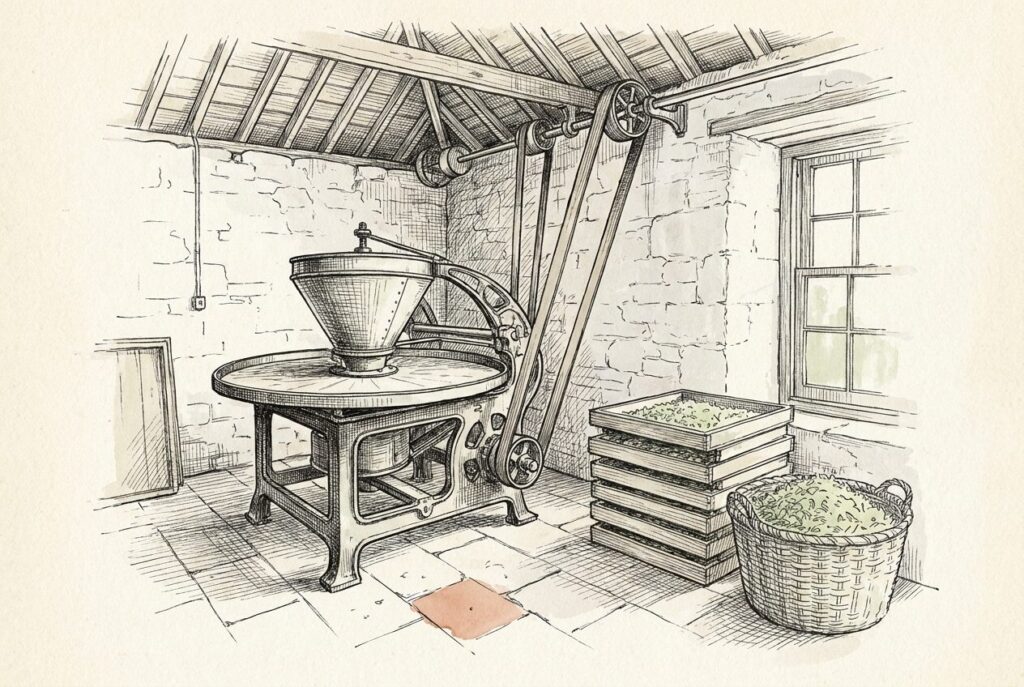
The visits page lists these rooms:
- Withering: freshly picked leaves lose some of their moisture and become more pliable.
- Rolling: the leaves are rolled to release their essential oils.
- Oxidation: in black tea, the leaf changes colour and gains flavour.
- Sterilisation: it removes impurities; in green tea, it also stops the leaf from oxidising.
- Drying: the leaves are dried to keep their flavour and aroma.
- Moinha: the leaves are separated so that only the best are used.
- Sorting: sieves sort the leaves by size and quality.
- Packing: the tea is packed to keep it fresh and full of flavour.
Besides the production rooms, the visit includes the exhibition room, with the first machines used to harvest and process the leaf (from the late 19th century), tools and historical documents.
There are also the shop and the tasting bar, which serves a selection of teas with Azorean specialities; the bar has recently been renovated and has an outdoor area overlooking the plantations and the ocean.
- Price
- Visit and tasting, free; no booking needed.
- Hours
- Monday to Friday, 8:00–18:00; Saturdays and Sundays, 9:00–18:00. The website does not distinguish seasons.
- Time
- 1 hour; the optional guided tour lasts 30 minutes.
- Getting there
- Bus 105 or 106 from Ponta Delgada, or by car to the factory car park (section 05).
- Note
- ERIH gives 8:00–18:00 at weekends too: if you go on a Saturday or Sunday, check on +351 296 442 349.
Source: Gorreana’s visits, contact, factory and history pages · checked on 15 Nov 2026. Visit time and guided tour: ERIH, the European Route of Industrial Heritage.
Tasting and the house teas
Visits and tastings are free and need no booking. The website does not say which teas are served at the tasting or what the bar charges.
This is how the online shop describes four of its loose-leaf teas:
- Hysson — green tea from the first three leaves of the plant, picked in July and August; the shop describes it as having a delicate aroma and an intense flavour
- Orange Pekoe — black tea that the shop describes as elegant, aromatic and balanced
- Pekoe — black tea with an aromatic, balanced profile and body, according to the shop
- Broken Leaf — black tea from the third leaf of the shoot, mild and light copper in colour; the shop recommends it for blending with other infusions, such as peppermint
The factory also produces moinha (particles of leaf that breaks during rolling), the green tea Encosta de Bruma and, in smaller quantities, oolong, pouchong, white and pearl.
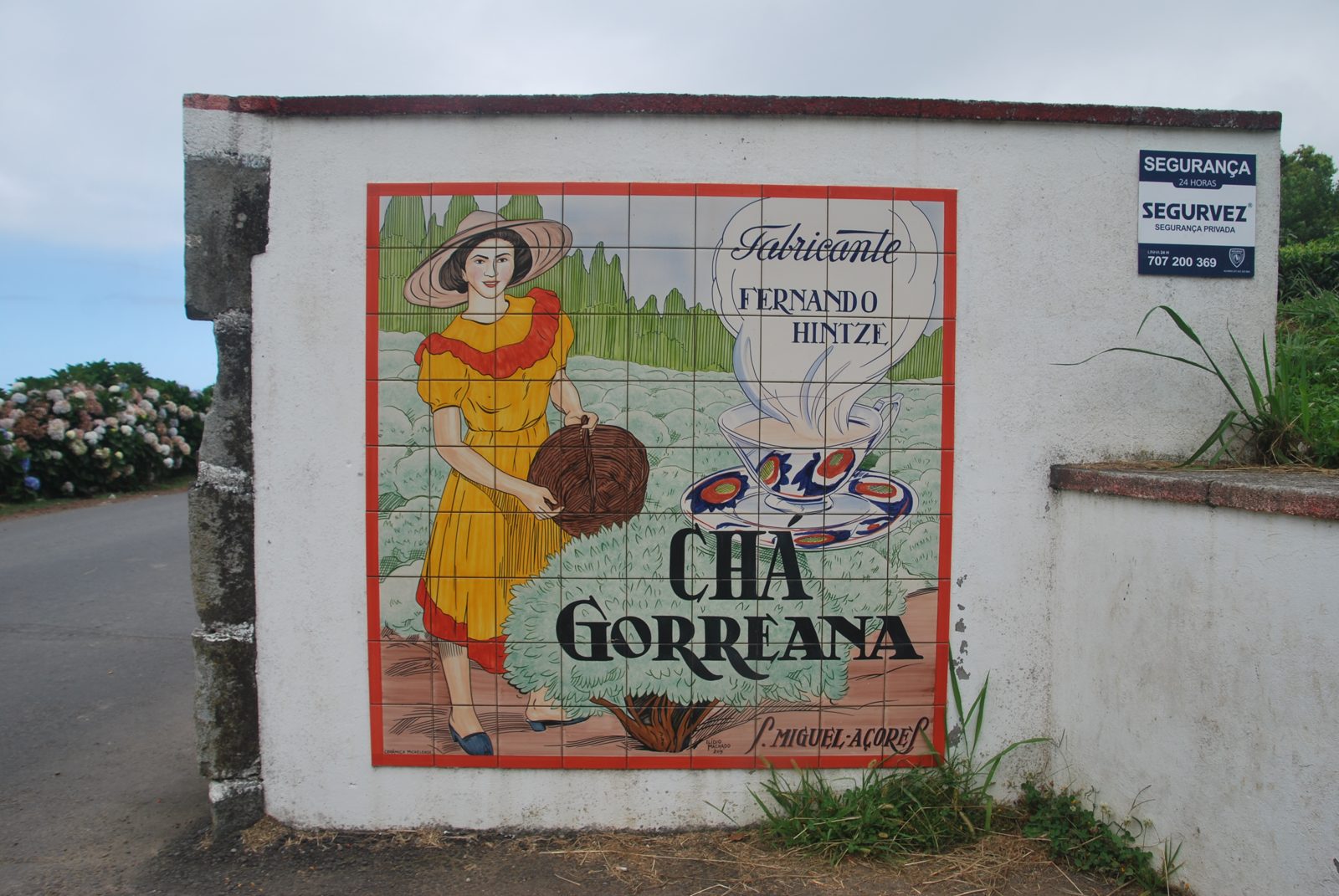
| Tea | Type | Size | Price |
|---|---|---|---|
| Hysson | Green | 80 g | €4.50 |
| Pekoe | Black | 80 g | €4.50 |
| Orange Pekoe | Black | 80 g | €6.96 |
| Broken Leaf | Black | 80 g · 250 g | €2.98 · €6.90 |
Source: Gorreana online shop (each tea’s page) and its history page (the other teas) · checked on 15 Nov 2026. The website does not publish factory shop prices.
A short history
1750: the official leaflet for the PRC28 trail places the arrival of the tea plant on the island in that year, on ships returning from the East. The Gorreana website speaks, without a year, of the second half of the 18th century.
1848: seeds brought from Brazil begin to be planted on several estates on São Miguel. Later, as technical knowledge was lacking, the Sociedade Promotora da Agricultura Micaelense, led by José do Canto, hired a Chinese tea master and his assistant and interpreter.
1883: Ermelinda Pacheco Gago da Câmara, owner of the Gorreana land, produces the first kilo of tea in the region. ERIH also gives 1883 as the year the plantation was founded.
1926: ERIH dates to that year the small hydroelectric power station that Jaime Hintze, who was married to Angelina Gago da Câmara, set up near the factory.
Hintze mechanised production with machines from Marshall, Sons & Company, the same ones used by José do Canto’s factory, and used the water of the stream that crosses the estate, which made production cheaper. According to ERIH, most of those machines are still in use.
The 1970s: the heirs of José do Canto abandon his factory, which had opened in 1883 between Ribeira Grande and Lagoa do Fogo. Gorreana has kept production going without interruption since 1883, and in 2011 it received the “Canto” brand from Canto’s heir in order to relaunch it.
Today: the plantation is still in the hands of the same family, now in its fifth generation. Its own pages do not give the same figures: the history page speaks of 32 hectares in one section and 37 in another, and of about 40 tonnes of tea a year; the factory page, of about 33.
Sources: Gorreana’s history and factory pages; ERIH (1883, 1926 and machines still in use); and the official PRC28 leaflet (1750) · checked on 15 Nov 2026.
Soil, climate and growing
According to the Gorreana website, the soil is clayey and acidic, and the climate is humid with plenty of rain. The plantation states that it grows its tea without herbicides, pesticides or fungicides, and that it has organic certification.
Gorreana presents itself as the oldest tea plantation in Europe, and the official leaflet for the PRC28 trail says the same. These are claims made by those sources, which this article has not checked against an independent record.
Nor is it the only tea factory on the island: the one at Porto Formoso states on its website (with a 2017 footer) that it produces black tea (Orange Pekoe, Pekoe and Broken Leaf) and that it offers a guided tour with tasting. Its current status is not confirmed by any official source.
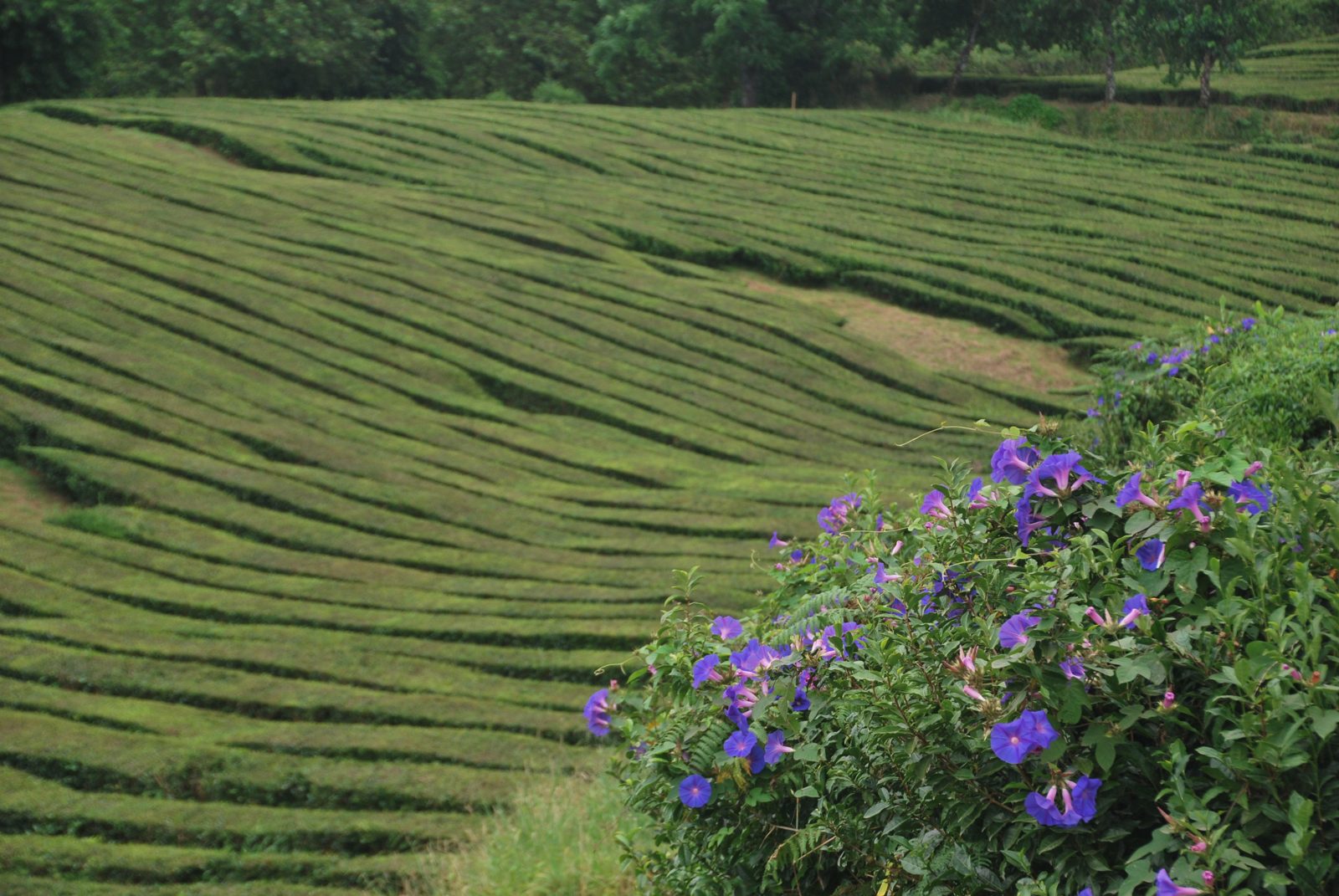
Sources: Gorreana’s history and FAQ pages; the PRC28 leaflet; the Chá Porto Formoso website · checked on 15 Nov 2026.
Getting there: bus from Ponta Delgada or car
On weekdays, the CRP company’s lines 105 and 106 link Ponta Delgada with Gorreana along the north coast.
- In Ponta Delgada, board line 105 or 106 towards Nordeste at the Av. Marginal (Alfândega) stop.
- Get off at the “Gorreana” stop: 51 to 58 minutes, depending on the departure.
- To return, the stop is called “Gorreana – Fábrica do Chá” in the timetable for lines 105 to 107.
- To see the factory and walk the trail, arrive on the 11:51 and return on the 17:31 (our own calculation from the timetable).
Ponta Delgada ⇄ Gorreana · weekdaysArrives
- Out · leaves 6:45
- 7:43
- Out · leaves 11:00
- 11:51
- Out · leaves 16:15
- 17:07
- Back · leaves 7:07
- 8:02
- Back · leaves 8:10
- 9:20
- Back · leaves 10:12
- 11:38
- Back · leaves 12:46
- 14:05
- Back · leaves 17:31
- 19:05
There are two later departures from Ponta Delgada, at 17:45 (line 108) and 18:15, which arrive at 18:37 and 19:07, when the factory has closed and there is no bus back that day (our own calculation from the timetable).
Source: Caetano Raposo & Pereiras (CRP), Monday-to-Friday timetable in force since 15 Sep 2025 · checked on 15 Nov 2026. Outbound, lines 105, 106, 108 and 113; return, lines 105 to 108 and 113. The timetable does not say how far each stop is from the factory.
At weekends, the timetable CRP publishes dates from 2018. Outbound, line 105 leaves Av. Marginal (Alfândega) at 6:45 and reaches Gorreana at 7:43 on Saturdays and 7:36 on Sundays; on Saturdays, line 112 leaves at 12:00 and arrives at 13:14. On the way back, the buses that stop at “Gorreana” leave before 8:10, when the factory has not yet opened.
In the afternoon there is no bus back from “Gorreana”, but there are buses from the Maia – Largo Sto. António and São Brás – Cantinho do Cais stops. Line 107 calls there at 15:44 and 15:47 on Saturdays (reaching Ponta Delgada at 17:04) and at 17:26 and 17:32 on Sundays (reaching it at 18:35). Line 111 calls there at 17:40 and 17:45 on both days (reaching it at 19:14). To get there, line 110 leaves Av. Marginal (Alfândega) at 7:15 and 15:15 and calls at São Brás at 8:10 and 16:10. The timetable does not say how far those stops are from the factory. Without a car, check on a weekday with CRP’s ticket office in Ponta Delgada (+351 296 285 244), which is closed at weekends.
By car, the plantation gives the address and the coordinates (37.8183649 N, 25.4024703 W): open the map. There is a car park at the factory, and the PRC28 trail starts from it, according to the official leaflet.
Practical details
- Address
- Plantações de Chá Gorreana, 9625-304 Maia, São Miguel (Azores), in the municipality of Ribeira Grande.
- Contact
- +351 296 442 349 (national landline call) and gorreanazores@gmail.com.
- Harvest
- April to October; Hysson is picked in July and August.
- Facilities
- Shop, bar with outdoor area and exhibition room. ERIH adds access for disabled people and a baby-changing table.
- Shipping
- The online shop delivers to mainland Portugal, the autonomous regions and other countries, as shown on the website. The customer pays postage, except in promotions, and it depends on weight, carrier (CTT or DHL) and destination: check in the basket whether your address can receive deliveries.
Source: Gorreana’s contact, history, shop and terms and conditions pages; facilities, ERIH · checked on 15 Nov 2026.
The PRC28 “Chá Gorreana” trail: 3.4 km through the plantations
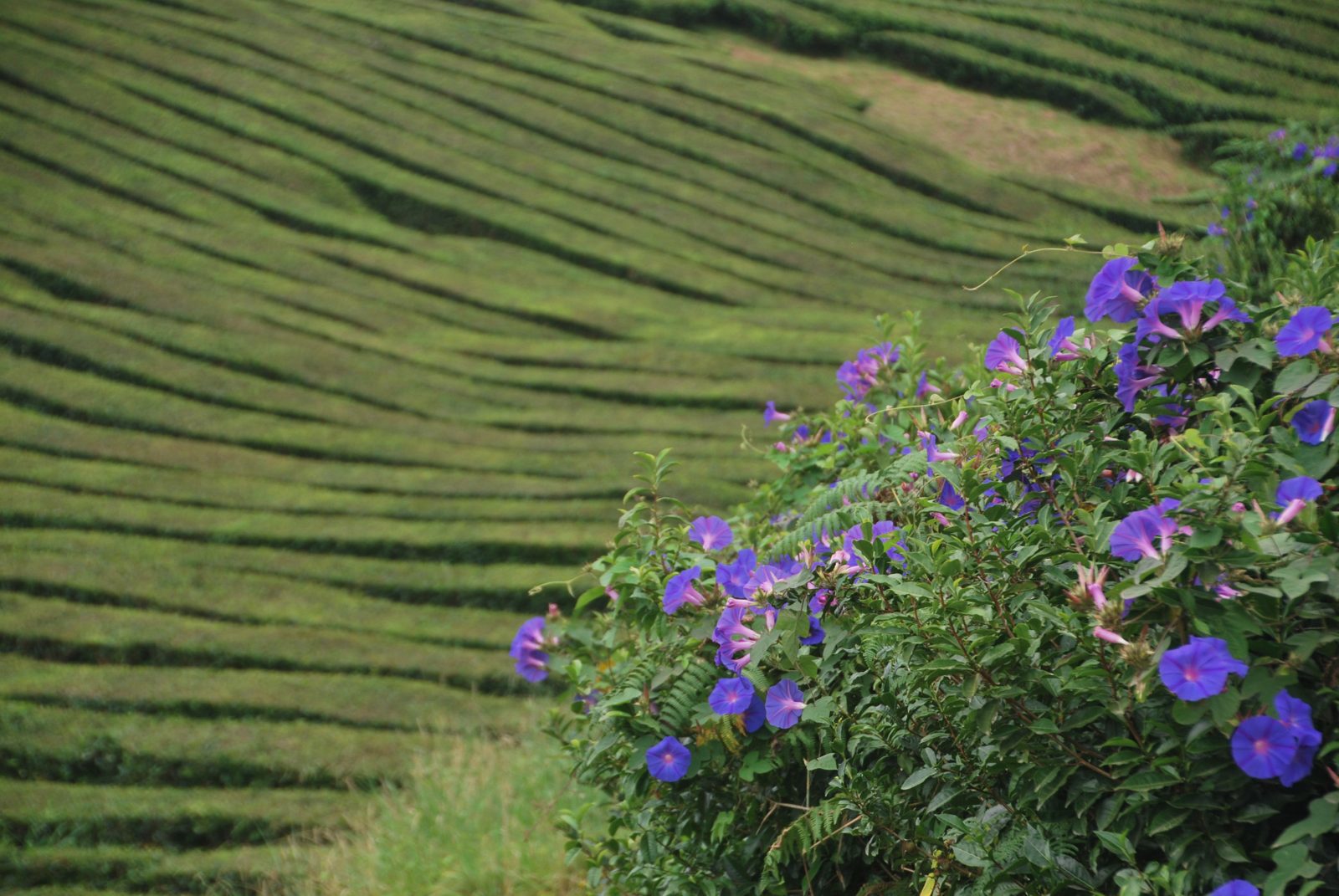
It starts at the factory car park and ends back at the factory. It is circular and runs through the tea plantations, woods of Japanese cedar (cryptomeria) and pasture; from its high section there are views of the island’s north coast.
- Distance
- 3.4 km, circular.
- Time
- 1 hour 30 minutes.
- Difficulty
- Easy.
- Note
- Tell someone your route and start time, take suitable equipment and food, stay on the trail and close any gates you open. Emergencies: 112.
Source: official PRC28 SMI leaflet from the Azores tourism board · checked on 15 Nov 2026. The same portal’s web page gives 3.3 km.
For the rest of the island, see the 7-day São Miguel itinerary; and if you are passing through Furnas, the cozido das Furnas recipe.
Sources
- Plantações de Chá Gorreana: visits, contact, history, factory, FAQ, shop and terms and conditions · official (the plantation) · admission, booking, hours, rooms, dates and figures, growing, teas, prices and shipping · checked on 15 Nov 2026
- Caetano Raposo & Pereiras (CRP) · bus operator · weekday timetable (in force since 15 Sep 2025), weekend timetable (since 7 Jun 2018) and ticket office · checked on 15 Nov 2026
- Azores tourism board: PRC28 SMI trail leaflet and its web page · official · trail, car park, 1750 and “oldest tea plantation in Europe” · checked on 15 Nov 2026
- ERIH, European Route of Industrial Heritage · European heritage network (third-party listing) · 1883, 1926, machines still in use, visit time, guided tour, hours and facilities · checked on 15 Nov 2026
- Chá Porto Formoso · company website (2017 footer) · production and tours · checked on 15 Nov 2026
More travel photography on Instagram: @vidaiatzen.
