
Xi’an 3-Day Itinerary: Terracotta Army, City Wall, Museums
The Terracotta Army (120 CNY) and the Shaanxi History Museum (free) can only be visited with an advance booking in your own name, made with your passport: with both booked before you fly, the three-day route falls into place.
By Ander BilbaoOwn photosPublished 15 min read
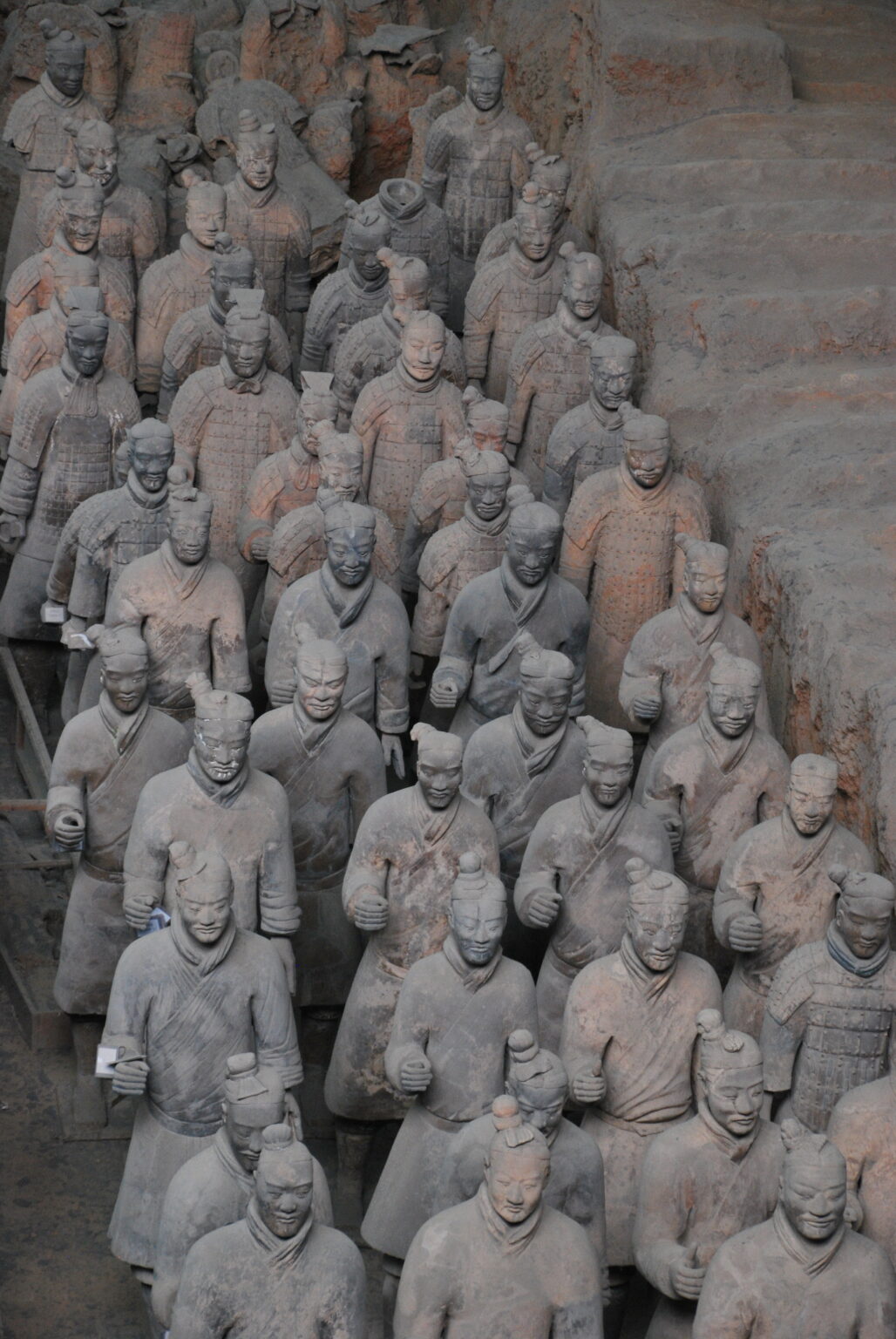
Xi’an in short
- Days
- 3: city wall and Muslim Quarter; Terracotta Army; pagoda and museum
- Bookings
- Terracotta Army online; museum 5 days ahead at 17:00; passport for both
- Tickets
- Terracotta Army and mausoleum, 120 CNY; history museum, free
- Out of town
- Terracotta Army: metro line 9 and bus; 2 h 26 min from the airport
- Mondays
- History museum closed until 14 Mar 2027, except national holidays
- Visa
- Spanish passports: visa-free for up to 30 days until 31 Dec 2026
Facts checked on 15 Nov 2026 with the Qin Shi Huang Mausoleum Museum (price, booking and routes), the Shaanxi History Museum (booking and winter hours) and Spain’s Ministry of Foreign Affairs (visa). The split into three days is our own suggestion.
Photographs by the author, taken on 5 August 2016 according to their metadata; the opening photo with a Nikon D60 and a Tamron 18-270 mm lens, according to its EXIF data. Prices and opening hours come from each site’s official website, with the source under each entry; where there is no official source, the entry says so. About me
Xi’an, in the middle of the Guanzhong Plain and today the capital of Shaanxi Province, was the capital of 13 Chinese dynasties and the starting point of the Silk Road.
Sources: Xinhua, on the Chinese Government portal (19 Dec 2024), and the municipal government · checked on 15 Nov 2026.
| Site | Ticket | Day |
|---|---|---|
| 01The Terracotta Army | 120 CNY, book ahead | Day 2 |
| 02Xi’an City Wall | No official price | Day 1 |
| 03The Muslim Quarter | Streets, no ticket | Day 1 |
| 04Giant Wild Goose Pagoda | No official price | Day 3 |
| 05Shaanxi History Museum | Free, book ahead | Day 3 |
| ·Before you plan | ||
| ·3-day Xi’an itinerary | ||
| ·History in 5 facts: the Terracotta Army | ||
| ·Logistics: getting there, entering China, weather and payments | ||
| ·Sources | ||
The Terracotta Army: how to visit
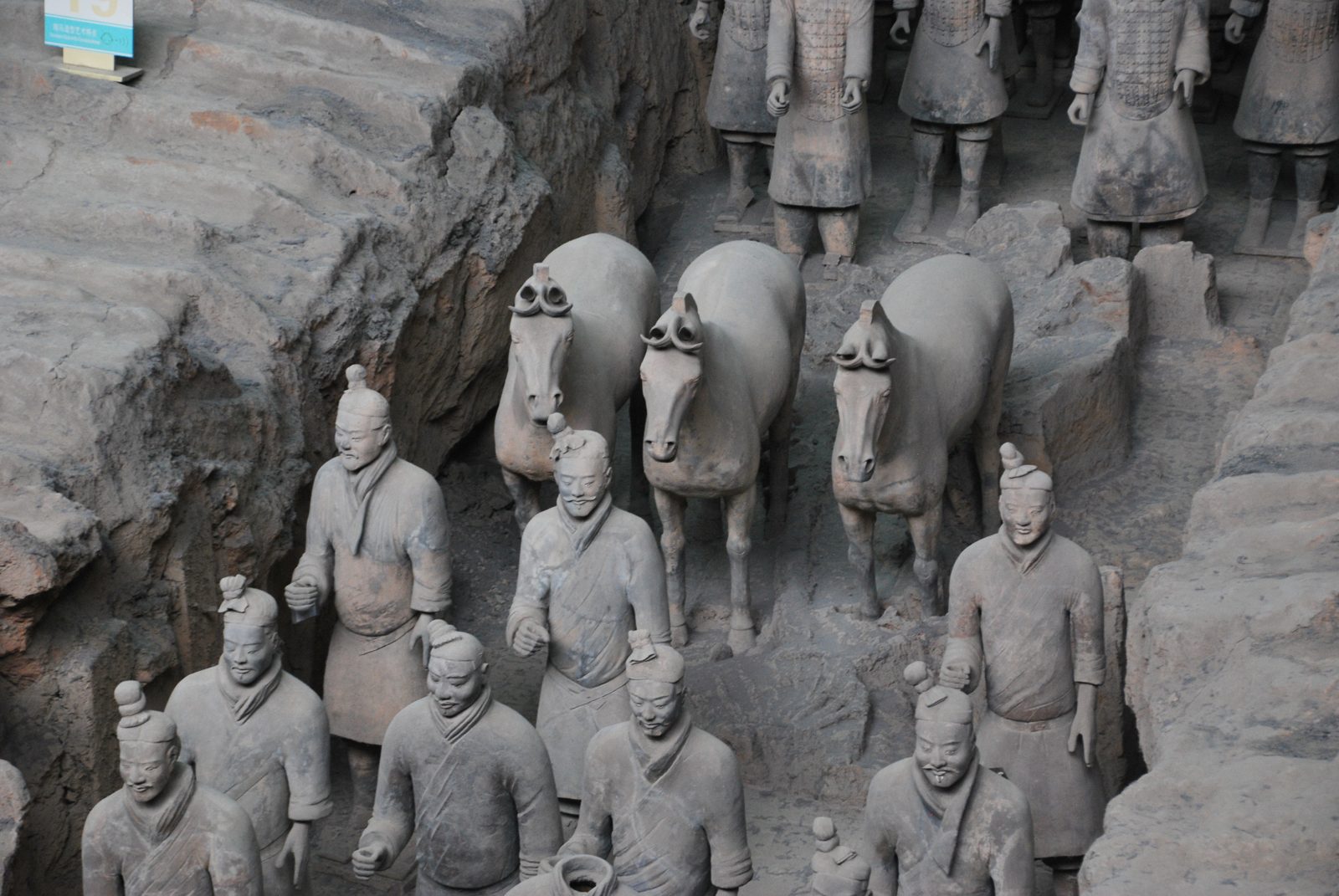
The Qin Shi Huang Mausoleum Museum (秦始皇帝陵博物院) is in Lintong District, within the municipality of Xi’an. Show the taxi driver the address in Chinese: 西安市临潼区秦陵北路.
In March 1974, farmers from Xiyang village were digging a well in the middle of a drought when they came across the pits. The museum describes the find as one of the great archaeological discoveries of the 20th century, and UNESCO inscribed the mausoleum, with its pits, in 1987.
Book before you leave. The museum only sells tickets online and in the visitor’s real name, foreigners included:
- Book on the official website or through the WeChat accounts ‘秦始皇帝陵博物院’ and ‘兵马俑票务在线’, using your passport details.
- Arrive half an hour before your time slot.
- Go in through the north gate, the only entrance, with your original passport.
- Get through entry control before it closes: see ‘Hours’ below.
The museum describes three pits:
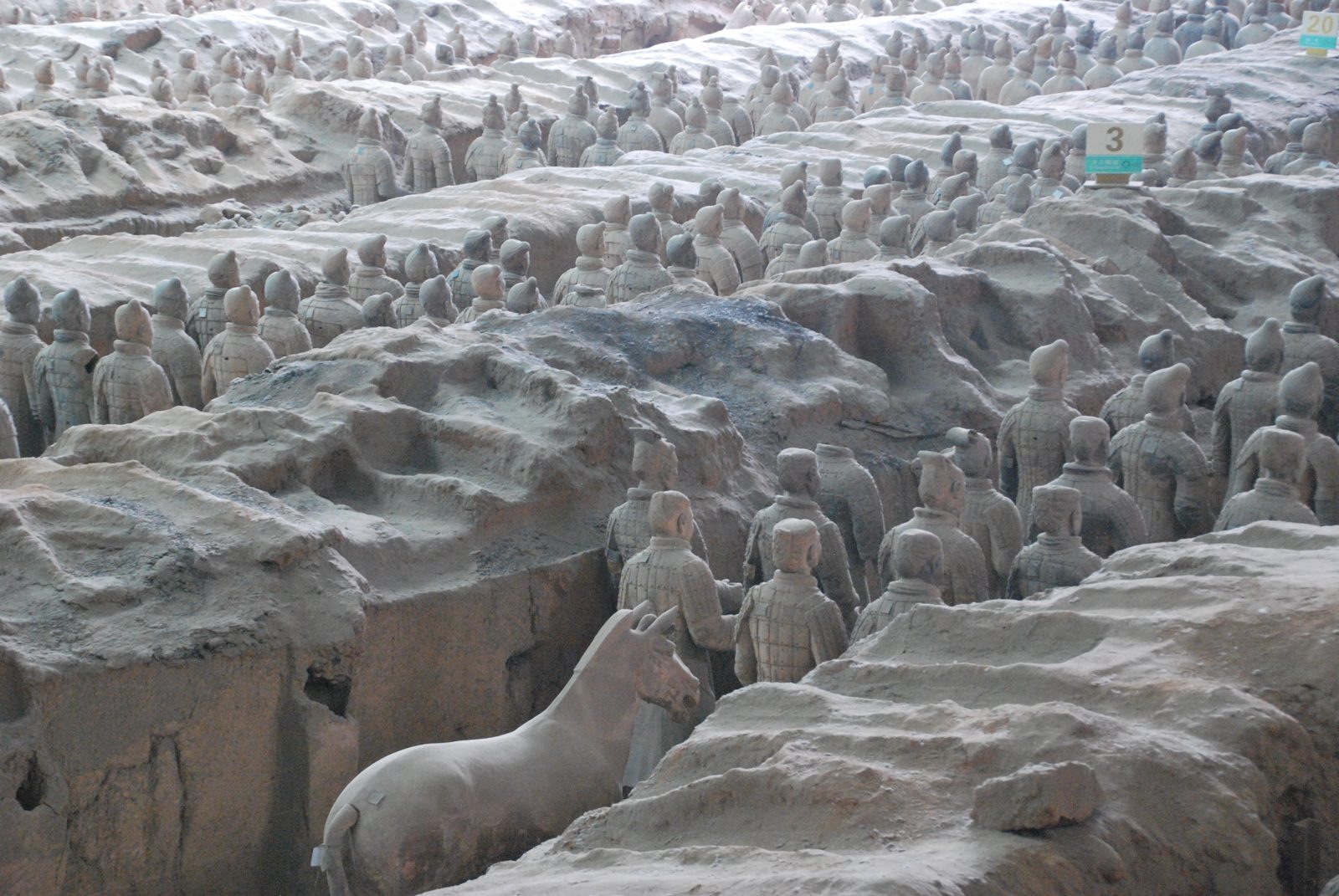
- Pit 1 (the largest): 14,260 m² and around 6,000 figures of warriors and horses, by the museum’s estimate; it has excavated more than 500 warriors, 24 horses and 6 wooden chariots.
- Pit 2: an L-shaped layout measuring 124 by 98 m, with crossbowmen, cavalry, infantry and four-horse chariots. It adds up to 939 human figures, 472 horses and 89 chariots.
- Pit 3: the smallest, at around 520 m², and the only pit in the complex that did not burn in antiquity, so it retains more traces of paint. It is interpreted as the command post for Pits 1 and 2.
Each site, the pits museum and the mausoleum park, takes around 90 minutes. The museum suggests a 1-hour route (Pit 1 and the bronze chariots hall) and a 2-hour one (Pit 1, Pit 3, Pit 2 and the bronze chariots).
Cameras and banned items. The official list of prohibited items includes drones, kites, megaphones, bicycles and scooters, and also ‘camera equipment’ (in the Chinese version, 摄像设备, recording equipment). It does not mention tripods or flash. If you are carrying more than a phone, ask first by email at information@bmy.com.cn or by phone on +86 29 81399127. The free left-luggage service does not accept phones, computers, drones or other digital devices.
- Price
- 120 CNY per adult, the same in high and low season. Valid for one day and includes the mausoleum park, 2,200 m away and linked by a free bus. The discounts on the Chinese-language website are for Chinese citizens; the English version exempts foreign children up to 1.4 m tall, but confirm beforehand on +86 29 81399127.
- Hours
- 16 March to 15 November: entry control from 8:30 to 17:00; the site closes at 18:30. 16 November to 15 March: from 8:30 to 16:30; it closes at 18:00.
- Getting there
- Metro line 9 to Huaqingchi (exit C) and bus 临潼游613 or 临潼602, or the direct bus from Tonghuamen (line 3). Step by step under Logistics.
- Watch out
- No booking in your name, no entry; the north gate is the only way in.
Source: Qin Shi Huang Mausoleum Museum, visitor information, guide, introduction and routes · checked on 15 Nov 2026. Pit figures: Pit 1 fact sheet and visitor information · checked on 19 Oct 2026. Note: a line in the guide says entry control closes at 17:00 at both sites; its own table and the ticketing page give 16:30 in the low season.
Xi’an City Wall: 13.78 km above the city
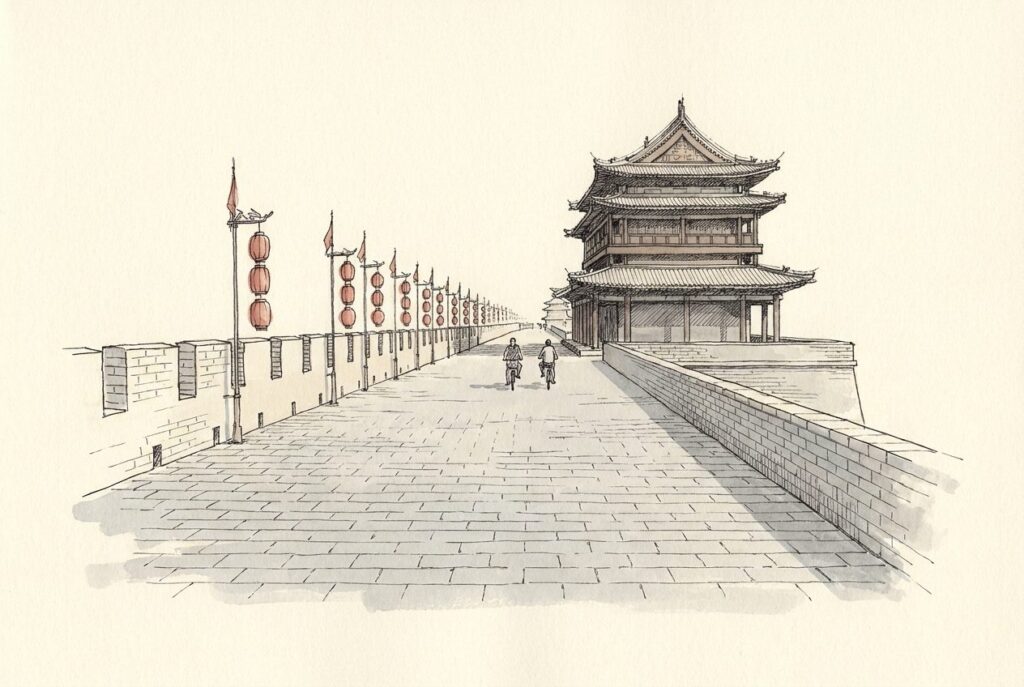
The Ming city wall of Xi’an was built on the foundations of the earlier city, extended to the east and north: the extension began in 1370 and work on the wall lasted from 1374 to 1378.
It has a perimeter of 13.78 km and a height of 12 m, with a width of 12 to 14 m at the top and 16 to 18 m at the base. It has 98 defensive towers on platforms that project from the wall and 5,984 crenellations. It has been a nationally protected cultural property since 1961.
Xi’an’s city wall is the largest and best preserved of the ancient city walls that remain in China, according to the Xi’an Local Chronicles Office.
Since September 2023, entry has been by timed slot booked in the WeChat mini program ‘西安城墙景区’, six days in advance and with no ticket offices on site, according to the press. That rule dates from 2023: before you go, check in the mini program whether it still applies.
- Price
- Not published on the official website: check when you book.
- Hours
- 8:00 to 22:00; some gates keep different hours.
- Getting there
- 16 access points since 1 May 2025, including the four main gates: south (Yongningmen), east (Changlemen), west (Andingmen) and north (Anyuanmen).
- Watch out
- Timed slots booked in ‘西安城墙景区’ (a 2023 rule).
Sources: Xi’an Local Chronicles Office (14 Apr 2022) and the official city wall website, hours and gates · checked on 15 Nov 2026. Access points and gates with other hours: CNR (29 Apr 2025); booking: CNR (23 Sep 2023). Both are press reports and could not be checked in the mini program.
The Muslim Quarter: where it is and what to eat
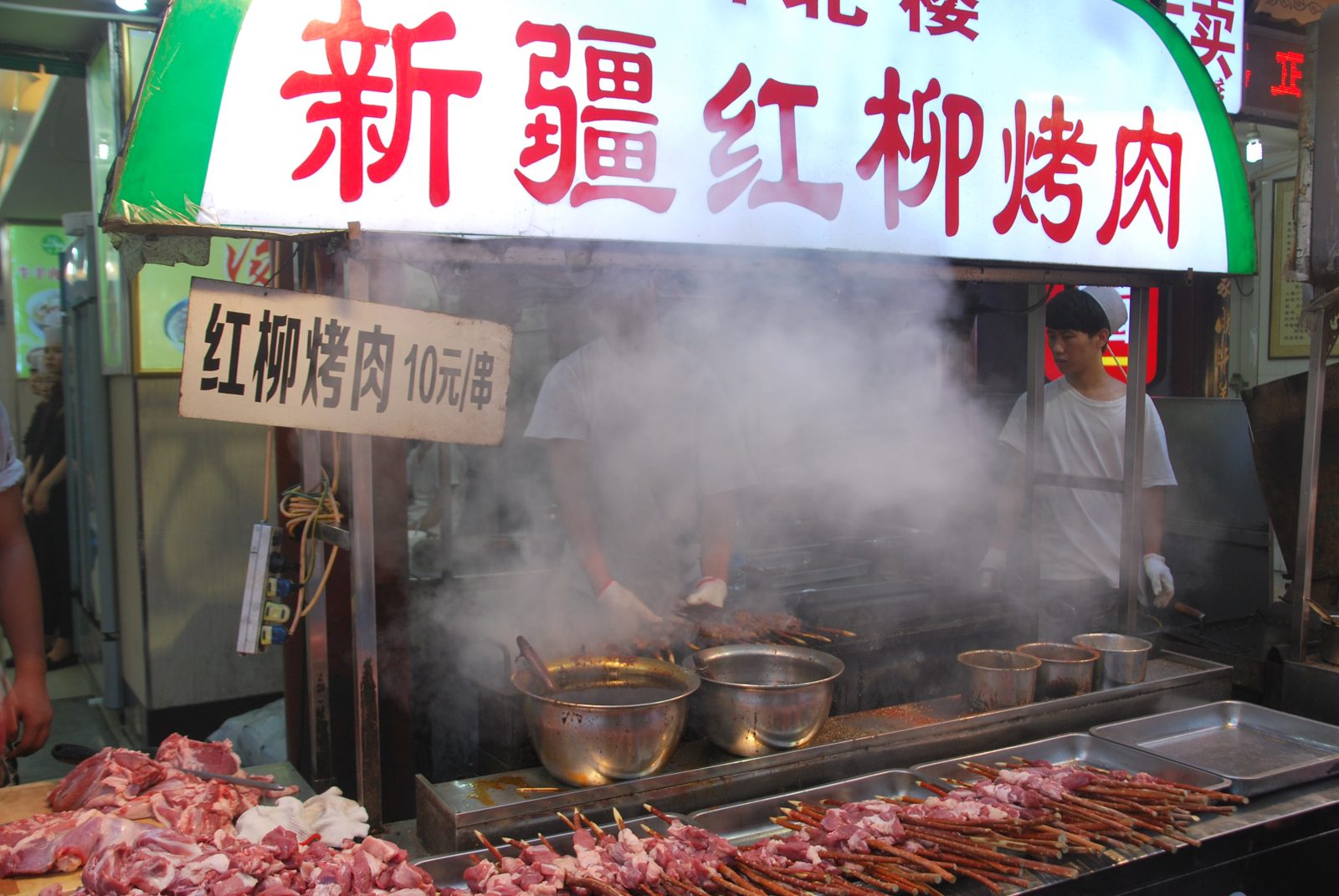
The Muslim Quarter (Huimin Jie, 回民街) is not a single street but several, such as Beiyuanmen, Beiguangji Jie, Xiyangshi and Dapiyuan. It begins next to the Drum Tower, about 200 m north-west of the Bell Tower; you enter through the arch beneath the tower.
The Hui, China’s Muslim minority, have lived there since the 10th century around the mosques; CNR counted ten in the quarter in 2005. The Great Mosque of Huajue Lane (化觉巷清真大寺) was founded in the year 742, has been a nationally protected property since 1988 and preserves buildings from the Ming and Qing periods.
What to eat
- Roujiamo (肉夹馍, ‘meat in bread’): braised meat inside a flatbread. The technique of the Fanji house (樊记腊汁肉夹馍) is provincial intangible cultural heritage. To make it at home, see our roujiamo recipe.
- Biang biang mian (biáng biáng 面): wide hand-pulled noodles.
- Yangrou paomo (羊肉泡馍): lamb soup with bread. Before it is cooked, the diner breaks the bread into pieces the size of a soybean; the technique of the Laosunjia house is national intangible cultural heritage.
- Guantang baozi (灌汤包子): steamed dumplings filled with broth. The technique of the Jia San house (西安贾三灌汤包子) is national intangible cultural heritage.
- Shizi bing (柿子饼): fried cakes made with persimmon.
Xi’an is the origin and centre of Shaanxi Muslim cuisine, according to China’s national intangible cultural heritage catalogue.
- Price
- Open streets, no ticket. The Great Mosque: no official price checked.
- Hours
- No official hours published.
- Getting there
- On foot from the Bell Tower: about 200 m north-west, to the Drum Tower.
Sources: streets and distance, official city wall website · checked on 15 Nov 2026. Dishes: Xi’an Government catalogue and ihchina.cn · checked on 15 Nov 2026. History of the quarter and the mosque: CNR (2005) and CNR (2013), press · checked on 19 Oct 2026.
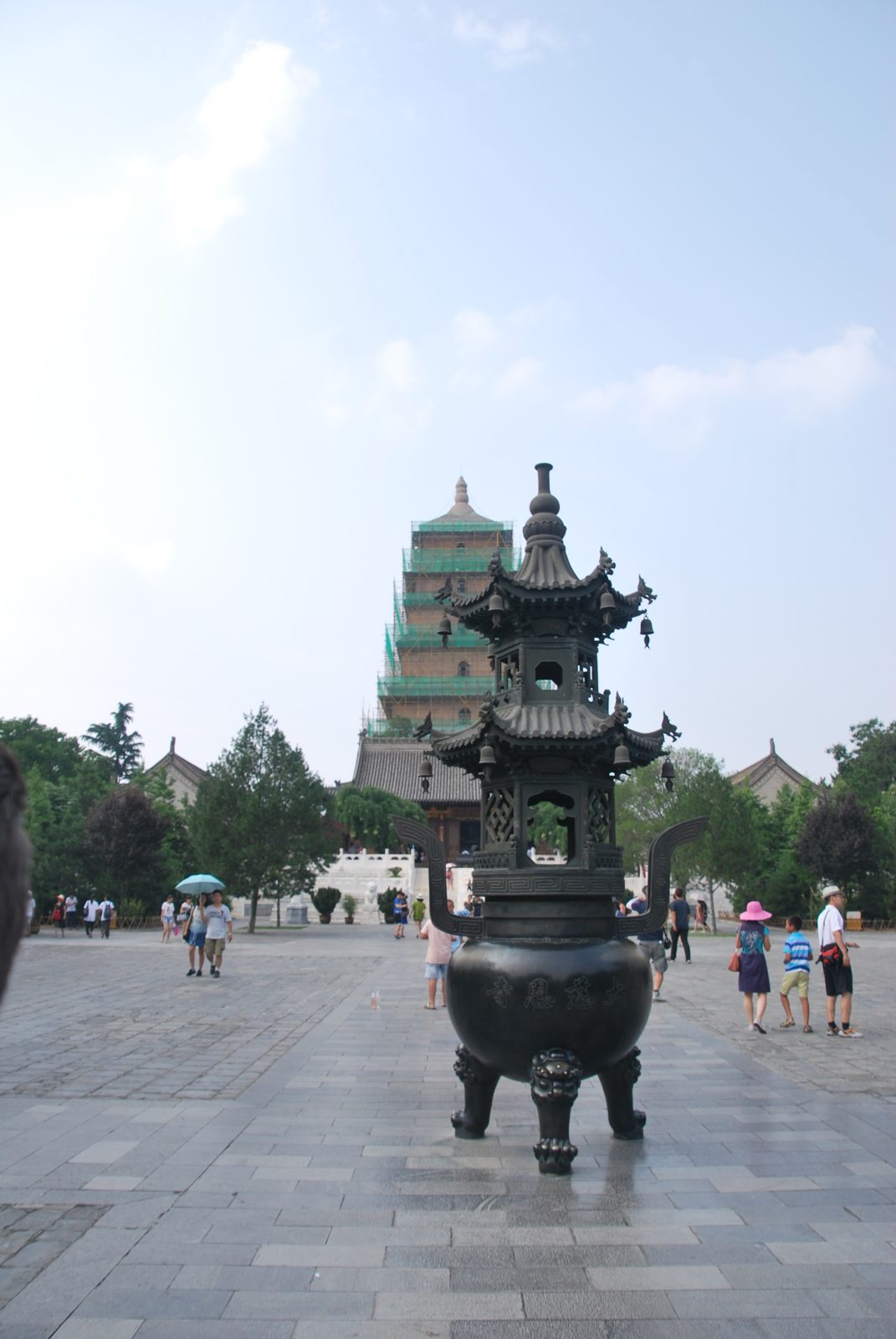
Giant Wild Goose Pagoda: seven storeys built between 701 and 704
In the year 652 the monk Xuanzang directed the construction of a five-storey pagoda to house the Buddhist scriptures brought from India. It collapsed about 50 years later and was rebuilt with seven storeys between 701 and 704.
It measures 64.517 m according to the Xi’an Local Chronicles Office and 64.1 m according to the National Cultural Heritage Administration, which describes it as the oldest and largest surviving square-plan brick tower from the Tang dynasty.
- Price
- No official source checked: confirm at the ticket office.
- Hours
- No official source checked.
- Getting there
- Dayanta metro station (lines 3 and 4), which carries the pagoda’s Chinese name.
Sources: Xi’an Local Chronicles Office (14 Apr 2022) and National Cultural Heritage Administration (2 Jun 2017) · checked on 15 Nov 2026. Station: Shaanxi History Museum website. None of these sources gives prices or hours, and travel agency websites disagree with each other.
Shaanxi History Museum: free, booked five days ahead
It opened on 20 June 1991 and describes itself as the first large modern national museum built in China after the reform and opening-up. Its collection numbers 1,717,950 items, according to its website.
Admission is free, but only with a booking in the visitor’s name through the WeChat account ‘陕西历史博物馆’; foreign visitors book with their passport. Tickets for the date five days ahead are released every day at 17:00, and each ID document allows one booking per day. Anyone who does not turn up and does not cancel before entry control closes cannot book for 180 days.
- Price
- Free, with a booking. The Tang dynasty mural exhibition has a separate ticket.
- Hours
- 15 November 2026 to 14 March 2027: 9:00 to 17:30, with entry control until 16:30; closed on Mondays, except national holidays. From 15 March: 8:30 to 19:00.
- Getting there
- 91 Xiaozhai Dong Lu (小寨东路91号), Yanta District. Xiaozhai metro station (lines 2 and 3), then 7 to 8 minutes’ walk east, or Dayanta (lines 3 and 4), then about 10 minutes west.
- Watch out
- No booking, no entry: book as soon as tickets are released, five days ahead.
Source: Shaanxi History Museum, guide, winter hours notice (9 Nov 2026), introduction and home page · checked on 15 Nov 2026. Entry-control closing time and Monday opening from 15 Mar 2027 have not been published yet.
Before you plan
- Mondays
- Until 14 Mar 2027 the Shaanxi History Museum is closed, except on national holidays: day 3 cannot fall on a Monday.
- Bookings
- Terracotta Army, online with your passport. History museum, at 17:00 five days ahead. City wall, timed slots in ‘西安城墙景区’.
- Winter afternoons
- From 16 Nov to 15 Mar, Terracotta Army entry control closes at 16:30; the history museum’s also closes at 16:30 until 14 Mar 2027.
- Outside the centre
- The Terracotta Army is in Lintong: metro line 9 and a bus, or the direct bus from Tonghuamen.
Summary of entries 01, 02 and 05.
3-day Xi’an itinerary
Suggested timings (AM, PM), fitted to each site’s opening hours (our own suggestion); the number takes you to the entry.
Day 1 · City wall and Muslim Quarter
Day 2 · Terracotta Army and mausoleum
Day 3 · Giant Wild Goose Pagoda and Shaanxi History Museum
With two days, combine days 1 and 3: the history museum in the morning, the city wall and the Muslim Quarter in the afternoon, and leave the pagoda for another trip (our own suggestion).
History in 5 facts: the Terracotta Army
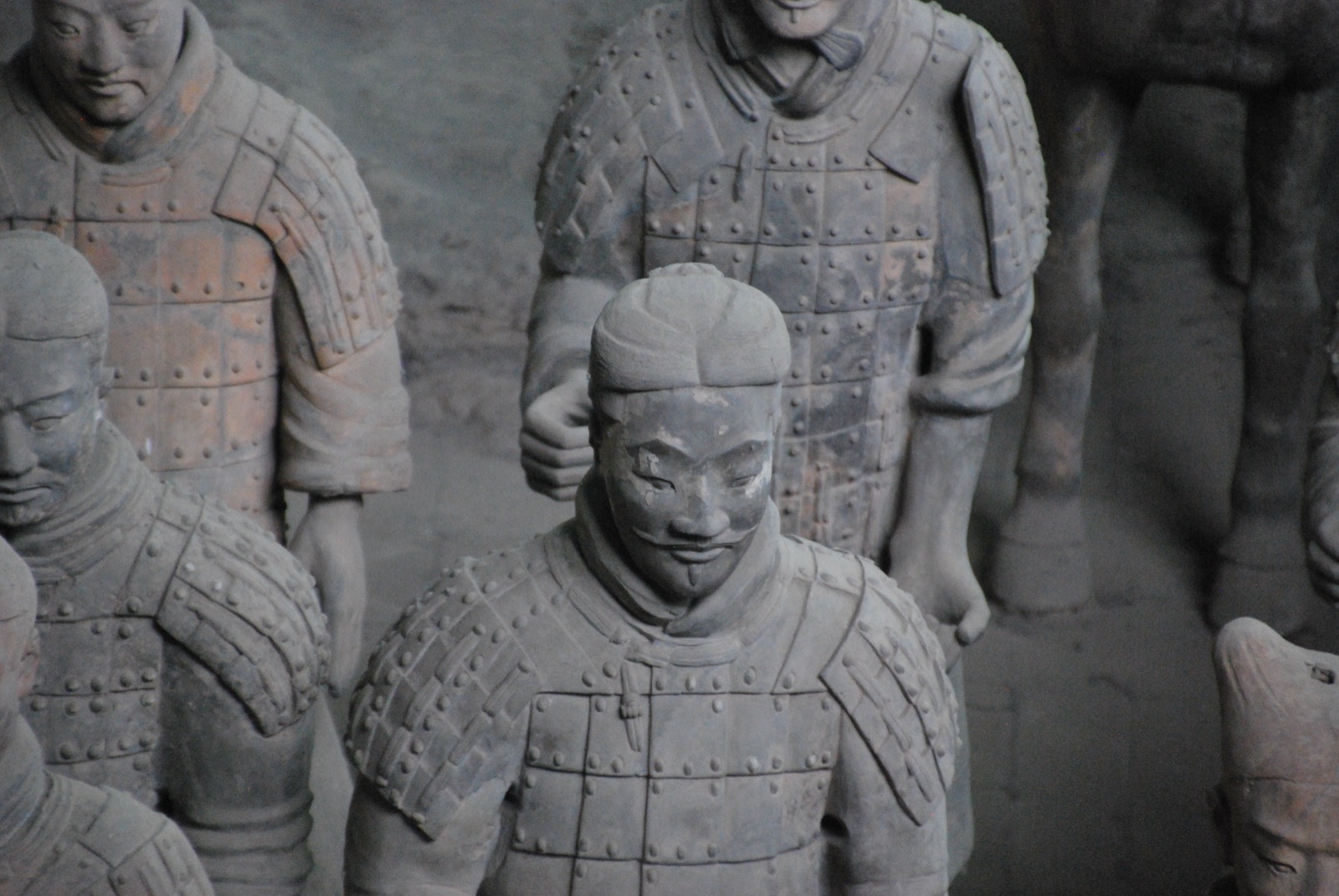
The Qin era left behind the Terracotta Army and, according to an undocumented tradition, the bread in roujiamo, Xi’an’s meat-filled flatbread (our roujiamo recipe explains why that is tradition rather than fact). What is documented fits into five facts:
- The first emperor. Qin Shi Huang unified China in 221 BCE and imposed a single system of writing, money, weights and measures across the land. He died in 210 BCE. (UNESCO)
- An army for the afterlife. It was buried with him in 210–209 BCE to protect him after death, laid out as if guarding the tomb from the east, where the states he had conquered lay. (Wikipedia)
- No two faces alike. The figures are life-size and, in UNESCO’s words, all different. The faces were made in moulds (possibly at least ten) and then built up with extra clay to give each one its own features. (UNESCO and Wikipedia)
- They were painted. Their pigments included cinnabar (red), malachite (green) and azurite (blue). Once excavated, the paint’s lacquer layer can curl within 15 seconds in Xi’an’s dry air and flake off in four minutes. (Wikipedia)
- Still underground. According to UNESCO, thousands of statues have yet to be unearthed and the emperor’s burial mound still stands 51.3 m high. The tomb beneath it has not been excavated. The historian Sima Qian wrote that mercury was used inside to imitate rivers and seas. Unusually high mercury levels measured in the soil of the mound lend weight to his account, although some attribute them to local industrial pollution. (UNESCO and Wikipedia)
Sources: UNESCO and Wikipedia, linked in each fact · checked on 16 Nov 2026.
Logistics: getting there, entering China, weather and payments
To the Terracotta Army by public transport
From Xi’an North station (西安北站), according to the museum:
- Metro line 2 to Beidajie (北大街).
- Line 1 to Fangzhicheng (纺织城).
- Line 9 to Huaqingchi (华清池); leave by exit C.
- Walk 197 m to the Huaqingchi bus stop.
- Bus 临潼游613 to Qinyongcun (秦俑村) or bus 临潼602 to Qin Bingmayong (秦兵马俑).
From Xi’an railway station (西安火车站), take line 4 to Wuluokou (五路口) and line 1 to Fangzhicheng; from there, as above.
There is also a direct bus, ‘兵马俑景区直通车’, which leaves from the Qinfeng stop (秦风发车场), 310 m on foot from exit D (north-east) of Tonghuamen station (通化门) on line 3. It is the one the museum suggests from the airport:
Airport → Terracotta Army≈ 2 h 26 min
- Line 14 from Jichang Xi
- → SHUANGZHAI
- Line 3, exit D
- → TONGHUAMEN
- Walk to Qinfeng
- 310 M
- Direct bus
- 直通车
- Walk to the museum
- 174 M
- Total
- 2 H 26 MIN
Source: Qin Shi Huang Mausoleum Museum routes · checked on 15 Nov 2026. It does not publish bus frequencies or fares. To return, take the same route in reverse.
Entering China: visa, arrival card and health
Entry rules depend on your nationality. The visa and health points below are those published for Spanish travellers by Spain’s foreign and health ministries; for any other passport, check your own government’s travel advice.
- Visa: holders of an ordinary Spanish passport do not need a visa for stays of up to 30 days for tourism, business, family visits, exchange or transit. The arrangement is valid until 24:00 on 31 Dec 2026; for a later trip, check whether it is extended.
- Arrival card: since 20 Nov 2025 it can be filled in online before the trip on the website of China’s National Immigration Administration (NIA), in its ‘NIA 12367’ app or in its WeChat and Alipay mini programs. Anyone who has not filled it in can do so on arrival at the immigration checkpoints.
- Accommodation: anyone staying in a private home must register at the nearest police station within 24 hours of arrival (72 hours in rural areas).
- Vaccinations: Exteriores states that none is mandatory and recommends tetanus, polio, rabies and dengue; it specifies that dengue is transmitted in coastal areas of the south and in parts of Fujian, Guangdong, Guangxi, Hainan and Yunnan. Sanidad only requires a yellow fever certificate, from the age of 9 months, from those arriving from countries with a risk of transmission or who have transited through their airports, and advises keeping your vaccination schedule up to date and visiting an International Vaccination Centre.
- Insurance and water: healthcare in China is not free and it is usual to pay up front. Exteriores recommends travel insurance with broad medical and evacuation cover, and drinking bottled water because tap water is not safe.
Sources: Exteriores (Spain’s Ministry of Foreign Affairs; China page last updated on 12 Jun 2026) and Sanidad (Spain’s Ministry of Health) · checked on 15 Nov 2026.
Money, payments, internet and language
- Currency: the yuan (CNY). Change euros or dollars at banks, hotels or official exchange offices. Check any 100 CNY notes you receive: counterfeits are in circulation.
- Payment: mobile payment (WeChat Pay and Alipay) is very common across the country and can be linked to an international credit card; Exteriores advises doing so before you arrive. Outside the big cities cards are not always accepted and some ATMs do not recognise international cards. Also carry cash in yuan.
- Internet: Facebook, YouTube, Google, Gmail, Twitter, Instagram and Spotify are not accessible from China. Before you leave, download offline maps, tickets and bookings.
- Language: carry the addresses of the places you will visit, and your hotel’s address, written in Chinese, and use a translation app.
Source: Exteriores · checked on 15 Nov 2026.
Weather: when to go
The municipal government describes a warm, dry and windy spring, a hot and rainy summer, a cool autumn with drizzle and a cold winter with little snow. September is the peak of the rainfall.
| Month | High | Rain |
|---|---|---|
| January | 4.8 °C | 6 mm |
| February | 7.7 °C | 11 mm |
| March | 14.0 °C | 26 mm |
| April | 20.4 °C | 50 mm |
| May | 25.8 °C | 65 mm |
| June | 31.6 °C | 51 mm |
| July | 32.0 °C | 93 mm |
| August | 31.1 °C | 67 mm |
| September | 24.7 °C | 108 mm |
| October | 19.3 °C | 66 mm |
| November | 12.1 °C | 26 mm |
| December | 6.1 °C | 6 mm |
Sources: World Meteorological Organization, with data from the China Meteorological Administration, and the municipal government, which gives an average of 26.9 to 27.5 °C in July and -1.2 to 0.7 °C in January for 1991-2020 · checked on 15 Nov 2026. Note: these are different periods.
Sources
- Qin Shi Huang Mausoleum Museum: visitor information, guide, routes and introduction · official · price, booking, hours, rules, routes and history · checked on 15 Nov 2026; Pit 1 fact sheet · pit figures · checked on 19 Oct 2026
- Shaanxi History Museum: guide, winter notice (9 Nov 2026), introduction and home page · official · booking, hours, Mondays, collection and metro · checked on 15 Nov 2026
- Official city wall website · official · hours, gates and Muslim Quarter · checked on 15 Nov 2026
- Xi’an Local Chronicles Office (city wall, Giant Wild Goose Pagoda) and National Cultural Heritage Administration · official · measurements and dates · checked on 15 Nov 2026
- Xinhua on the Chinese Government portal; Xi’an municipal government (location, climate, intangible heritage); ihchina.cn · official · background, climate and dishes · checked on 15 Nov 2026
- World Meteorological Organization · official · weather by month · checked on 15 Nov 2026
- Exteriores and Sanidad (Spain’s foreign and health ministries) · official · entry to China, health, money and internet · checked on 15 Nov 2026
- CNR: city wall access points (2025), its booking rule (2023), Muslim Quarter (2005) and Great Mosque (2013) · press · checked on 19 Oct 2026
- UNESCO World Heritage List: Mausoleum of the First Qin Emperor · official · history of the mausoleum and the army · checked on 16 Nov 2026
- Wikipedia: Terracotta Army and Mausoleum of Qin Shi Huang · encyclopaedia · burial, faces, paint and tomb · checked on 16 Nov 2026
No official source found: price and hours of the Giant Wild Goose Pagoda, price of the city wall and hours of the Muslim Quarter. Each entry says so.
Photography by Ander Bilbao (@vidaiatzen). The date each fact was checked is listed in the sources. Published on Bidaiatzen.
