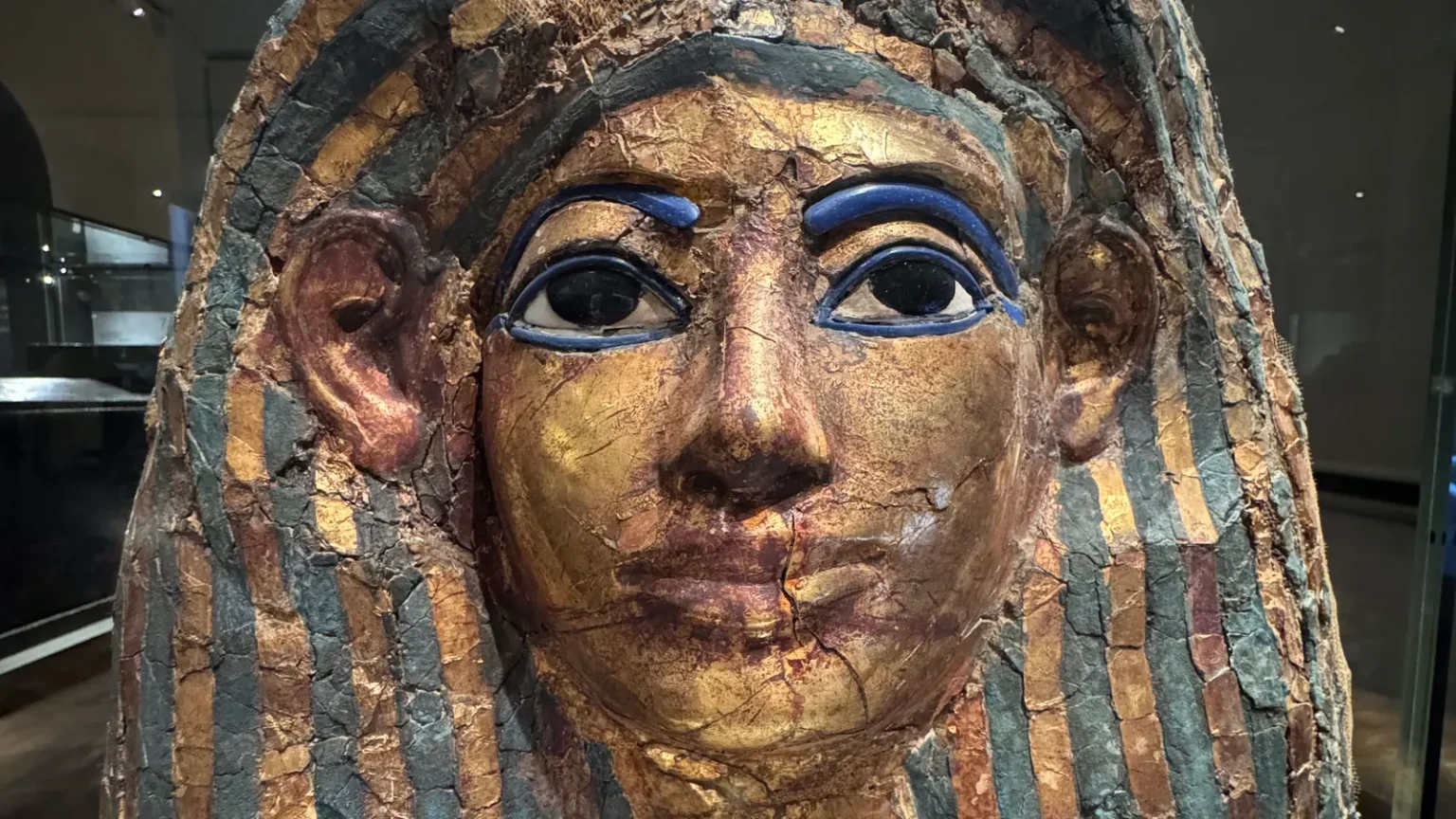
The Egyptian Museum of Turin (Museo Egizio) occupies a palace in the city centre, a 10-15 minute walk from Porta Nuova according to the museum, which states that tickets are bought online for a fixed time slot. The museum’s pages were re-read on 23 Nov 2026. This guide brings together prices, hours and rules, flags where those sources disagree and includes photos of the museum.
How to get to the Museo Egizio
The museum is at Via Accademia delle Scienze 6, in the former Collegio dei Nobili, a palace which, according to its history, it shares with the Academy of Sciences. From 2 pm on 23 Nov 2026, according to a notice on the portal, the only entrance is on Via Eleonora Duse; ‘Materia’ is entered from Via Maria Vittoria.
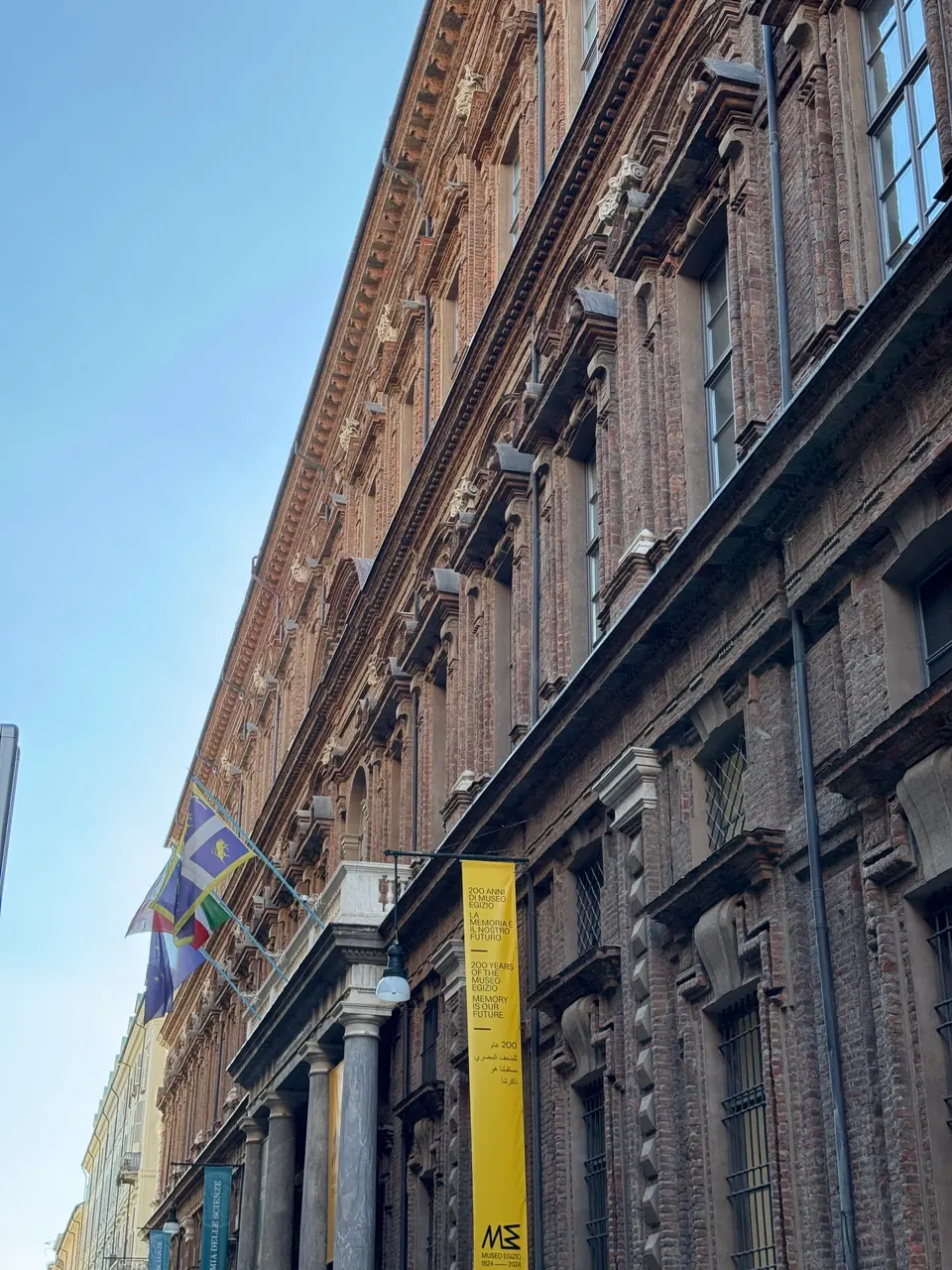
From Porta Nuova, the museum estimates a 10 to 15 minute walk along Via Lagrange or Via Roma; from Porta Susa, 20 to 25.
By public transport, its directions page cites the Porta Nuova stop on metro line 1 and, from that station, buses 58 and 58B or tram 4; from Porta Susa, buses 51, 56, 57, 72 and 72B or tram 13. The stop it gives is Bertola, and Castello for the 56 and tram 13 from Porta Susa. This is the only source: check the GTT journey planner before you go, because routes can change.
The GTT City ticket (checked on 23 Nov 2026) costs €1.90 digital or €2.00 on paper and is valid for 100 minutes from the first validation, with a single metro journey. GTT accepts contactless cards on some buses, but does not list trams 4 and 13: carry a ticket you have already bought.
Egyptian Museum of Turin tickets and hours in 2026
Data read on the museum’s website and on its portal on 23 Nov 2026 (Turismo Torino, on 3 Nov); each row gives its source. Prices and hours change: check them again on the day you book.
| Item | Details | Source |
|---|---|---|
| Full-price ticket | €18 (bought online). | FAQ · prices |
| Reduced rates | €15 for people over 70 and registered journalists · €3 for ages 15 to 18, university students and National Youth Card holders · €1 for ages 6 to 14 · €36 family ticket (2 adults and 2 under-18s). | FAQ · prices |
| Free | Ages 0 to 5; people with disabilities and one companion; holders of the Abbonamento Musei Torino Piemonte and of the Torino+Piemonte Card; other categories in the FAQ. The free ticket is also obtained online (see below). | FAQ in Italian · accessibility |
| Hours | Monday 9:00-14:00 · Tuesday to Friday and Sunday 9:00-18:30 · Saturday 9:00-20:00 (every Saturday in 2026, according to its accessibility page). | hours · accessibility |
| Last entry | One hour before closing: Monday 13:00; Tuesday to Friday and Sunday 17:30; Saturday 19:00 (times calculated from the closing time). | hours · regulations (PDF) |
| Purchase | Online and for a set time slot; no entry before the booked time; no changes or refunds. The museum says it does not sell tickets on its premises. On sale up to 6 Jan 2027. | FAQ · ticket portal |
| Torino+Piemonte Card | Includes the Egizio, with a free ‘Ingresso CARD’ ticket booked online. 24h* / 48h / 72h / 120h: €29.90 / €39.90 / €45.90 / €52.90; 72h Junior: €18.90. *Maximum of three museums. The page dates the prices ‘from 3 Mar 2025’. | Turismo Torino |
| Holidays and special openings | The hours page lists no closures in 2026 and does not include 25 and 26 Dec. Special openings, according to its month selector: 23 to 29 Nov (9:00-22:00); 6 and 7 Dec, 27 to 30 Dec, 1 Jan and 3 to 5 Jan 2027 (9:00-20:00; the museum’s English page says 22:00 on 6-7 Dec and 4-5 Jan); 24 Dec (9:00-14:00). The portal sells the ‘Be the First’ ticket (€25) for 5 to 8 Dec, to enter before the usual opening time. Confirm the dates on the day you go. | hours · ticket portal |
Purchase. The museum’s FAQ says tickets can only be bought online and are not sold at the museum; its portal adds that entry is guaranteed only with an online ticket. The March 2025 regulations allow on-site sales depending on the level of online sales, and the FAQ and the accessibility page mention an access desk for validating rates and handing out wheelchairs. Given that discrepancy, turning up without a ticket is not advisable.
Entry margin and price. The margin for entering is 15 minutes according to the FAQ and 20 according to the portal: count on 15. The €18 comes from the FAQ, the price list and Turismo Torino; the portal did not allow it to be checked: check the total before paying.
Free entry. The museum asks for the free ticket to be obtained online as well; its accessibility page recommends it only to people with disabilities. For them the sources differ: the FAQ and that page set no degree, the prices page says ‘severe disability’ and the portal, ‘invalidity above 74%’; bring documentation and confirm it beforehand. With the season pass or with the Torino+Piemonte Card, the named card and a document are shown at the access desk. No official listing read on 3 Nov includes a free first Sunday.
23 to 29 Nov 2026 only. ‘Notturni immersivi’ (Immersive Nights): free entry from 19:00 to 22:00 with a place booked on the portal, according to the museum’s programme.
Torino+Piemonte Card. According to the museum, it gives no priority at the access desk and, according to Turismo Torino, time slots sell out quickly on long weekends and public holidays. For visiting the Egizio alone, the cheapest adult card (€29.90, 24h) costs more than the €18 ticket.
The floors of the Egizio: what is on each one
This guide does not propose a route. According to its PDF map (November 2024) and its accessibility page, the chronological order starts on floor 2 and continues on floor 1; the other floors are thematic:
- Floor 2 · rooms 2 to 5. From the Predynastic Period and the Old Kingdom (room 2) to the Middle Kingdom and the New Kingdom (room 5, labelled with both).
- Floor 1 · rooms 6 to 13. From Deir el-Medina (room 6) and the tomb of Kha and Merit (room 7) to the Roman and late antique period (room 13).
- Ground floor. The Gallery of the Kings (room 14, according to the map website and the catalogue) and ‘Materia. The shape of time’; the Chapel of Ellesiya appears here on the plan.
- Floors 3 and -1. The Gallery of Writing (3) and the history of the museum (-1).
The map website speaks of four floors but lists five, and puts the temporary exhibitions on floor 3: this guide follows the PDF. The Kha and Merit room (room 7) reopened on 4 Dec 2025, according to the museum’s news item.
What to see at the Egizio: ten pieces and rooms
Named are the pieces whose label can be read in this guide’s photos and, without a photo, two from the official catalogue; the rest are described. Floor and room only if the catalogue or a label gives them.
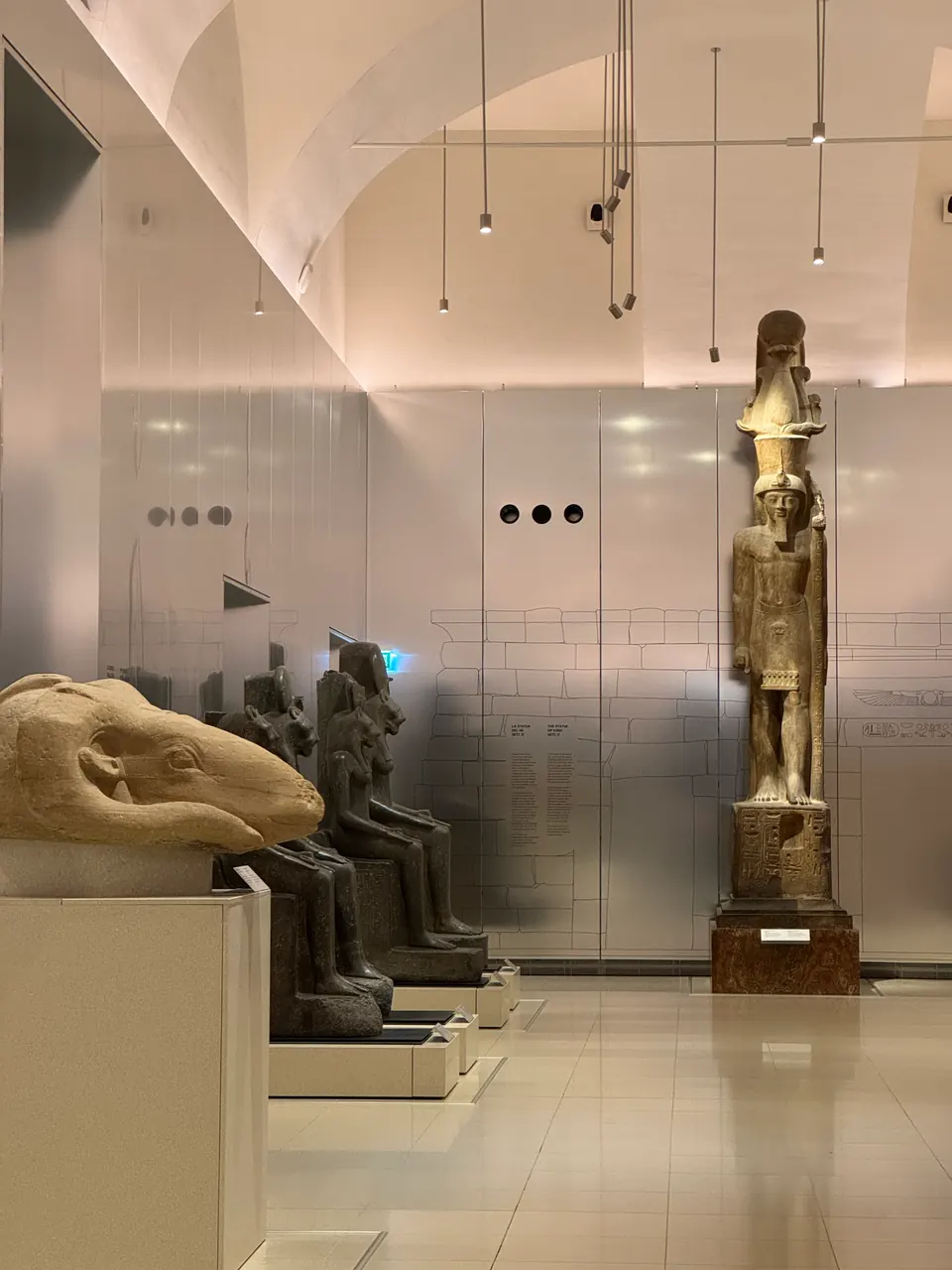
Statue of Ramesses II (ground floor, room 14)
According to the online catalogue, a granodiorite statue from 1279-1213 BCE (Dynasty XIX): the king in the khepresh crown and, beside his legs, Nefertari and his son; Drovetti bought it, in 1824. The museum considers it one of its symbols.
Turin King List (floor 3, Writing Gallery)
The catalogue records it as the Turin King List (Cat. 1874): a papyrus from the reign of Ramesses II, acquired in 1842, in frame 01 of that gallery. Nothing confirms it is on display today: ask at the ticket desk.
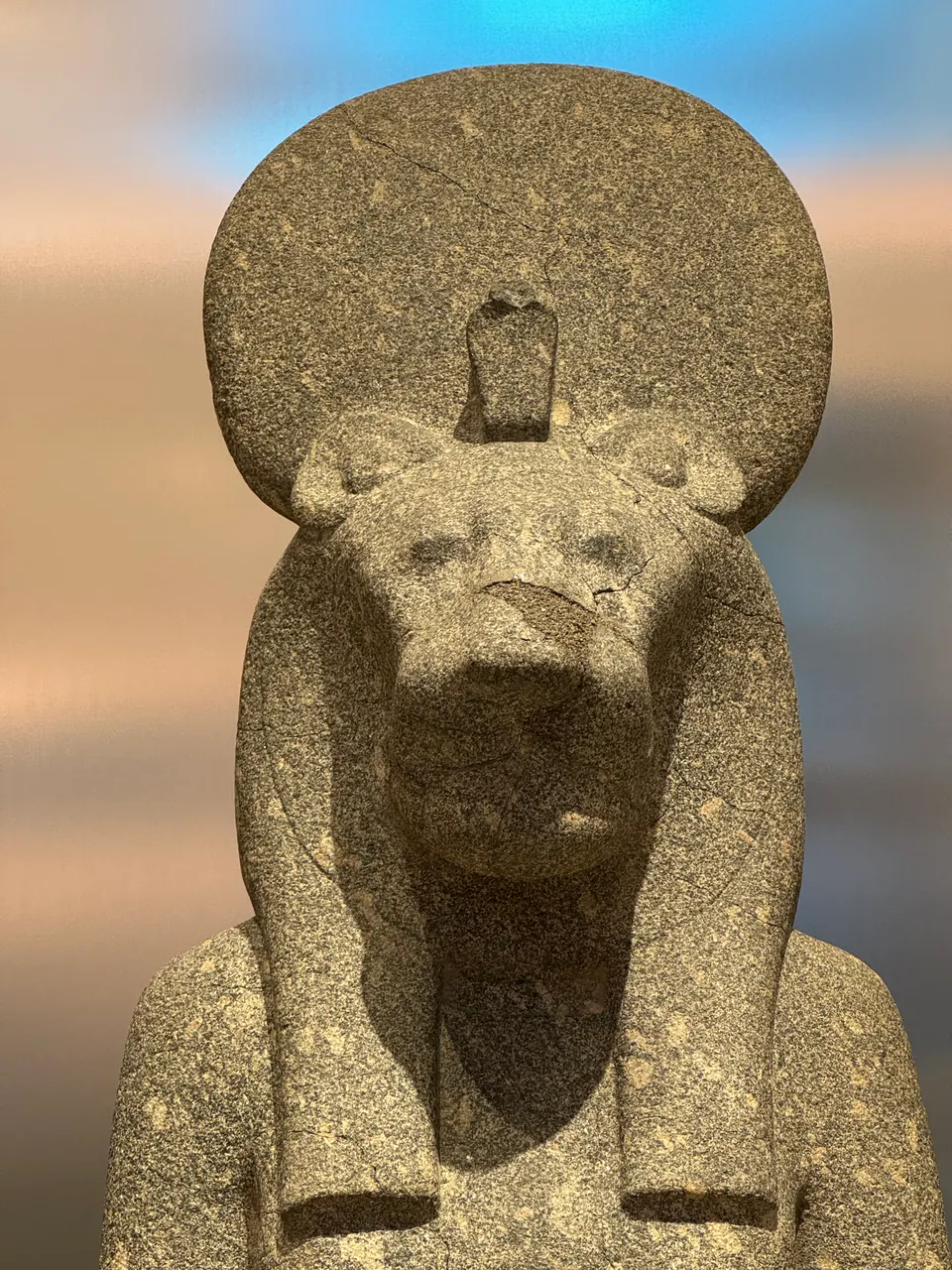
Statues of Sekhmet (ground floor, room 14)
Four lioness-headed statues in a row beside a window. The labels of the first two (C. 262 and C. 261) refer to the goddess Sekhmet and give granodiorite, New Kingdom, Dynasty XVIII, reign of Amenhotep III, Luxor (Karnak, Temple of Ptah) and the Drovetti collection (1824); the online catalogue places them in room 14.
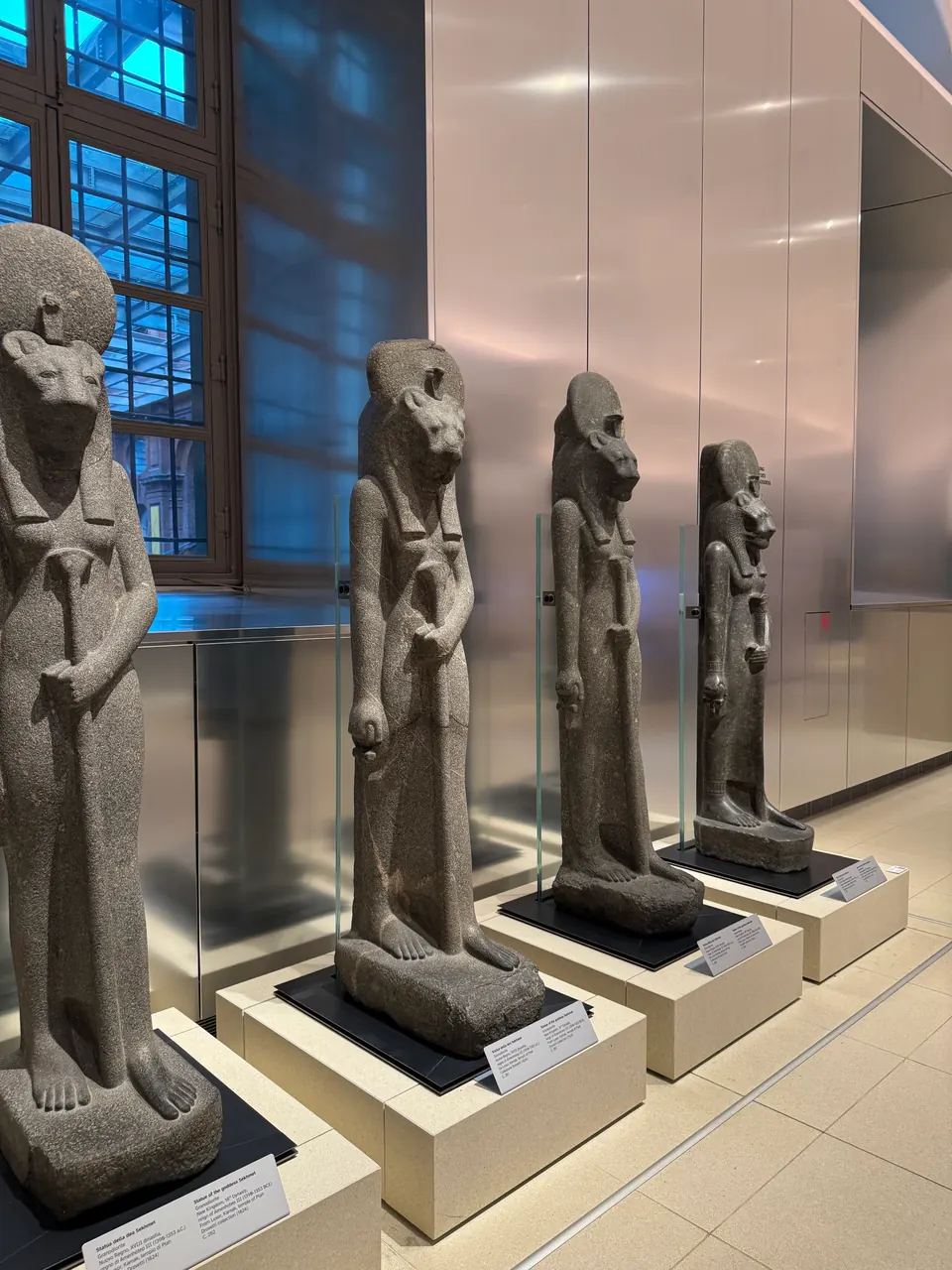
Close up, the head of a statue of the same type: cracked sun disc, cobra on the forehead and tripartite wig.
Speckled stone sarcophagus lids
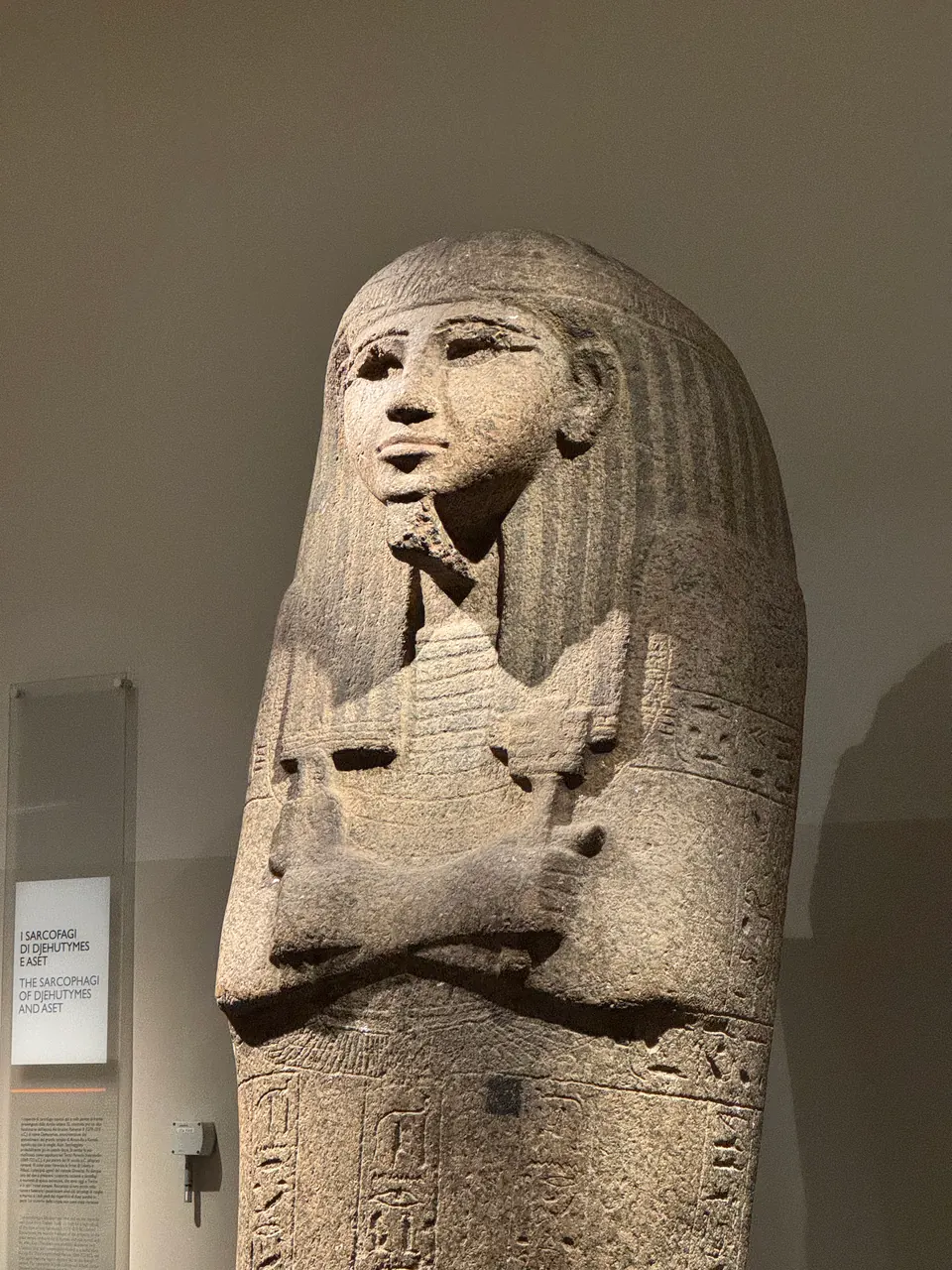
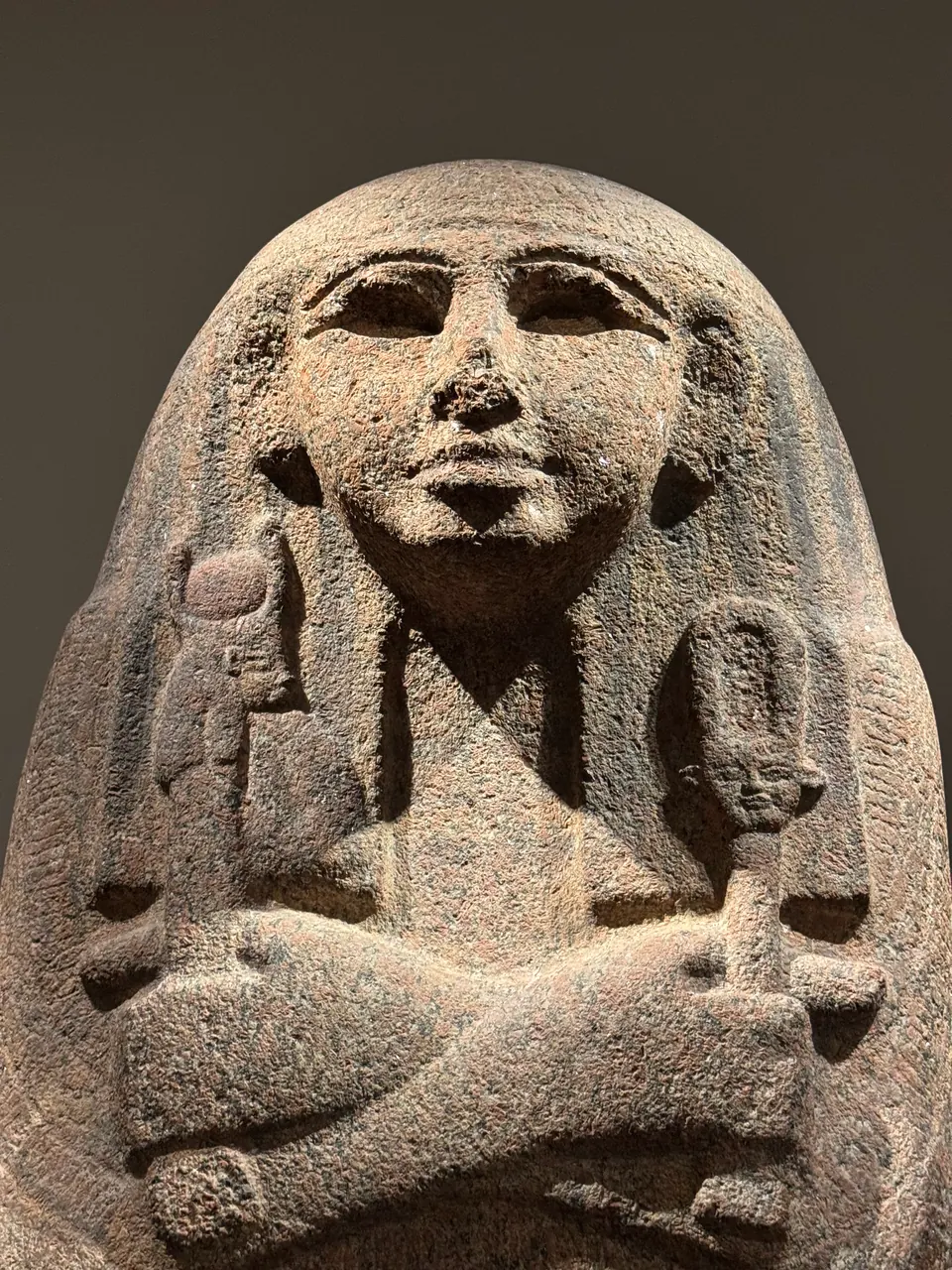
Next to a sarcophagus lid in dark speckled stone, with a long wig and crossed arms, a room panel is titled ‘I sarcofagi di Djehutymes e Aset / The sarcophagi of Djehutymes and Aset’. Another, more reddish lid, with hollow eyes and eyebrows, has two reliefs beside the chest.
Montuemhat’s funerary cones
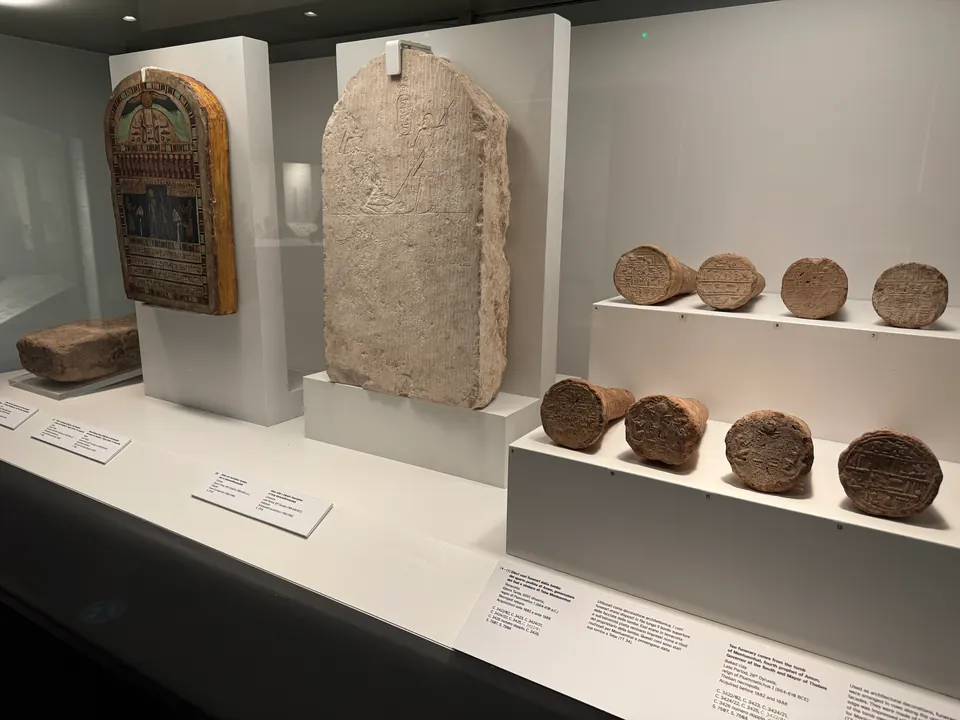
In a display case, beside two stelae, there are eight terracotta cones with inscriptions. The label refers to ten cones from the tomb of Montuemhat, Fourth Prophet of Amun and Mayor of Thebes: Late Period, Dynasty XXVI, reign of Psamtik I.
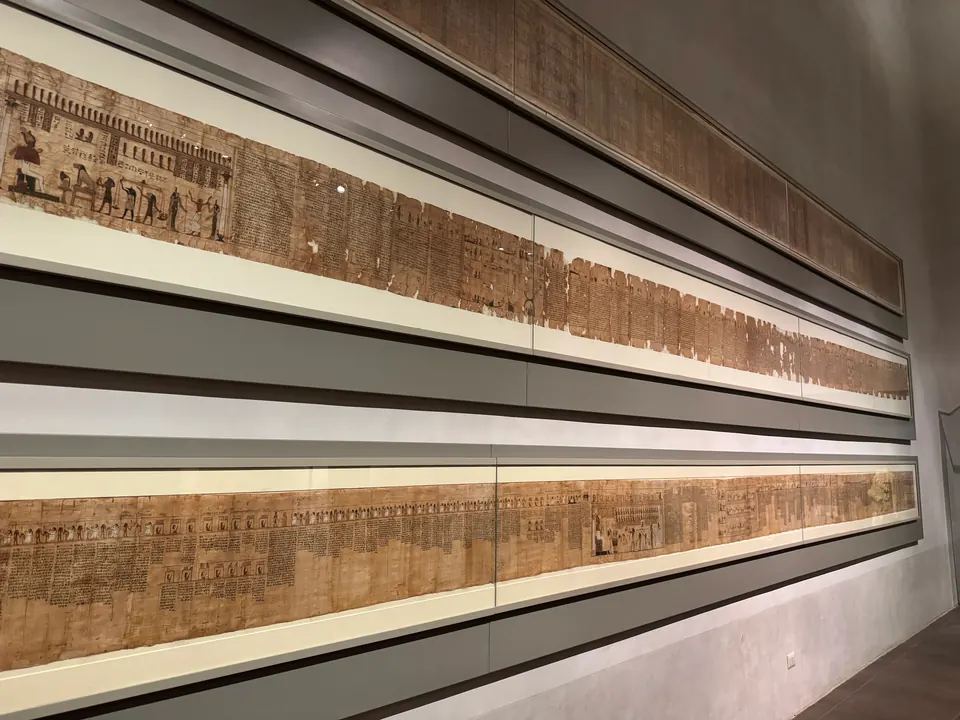
Long papyri in display cases
Three bands of long papyri in horizontal display cases; to the left of the central one there is what looks like a judgement-of-the-dead scene.
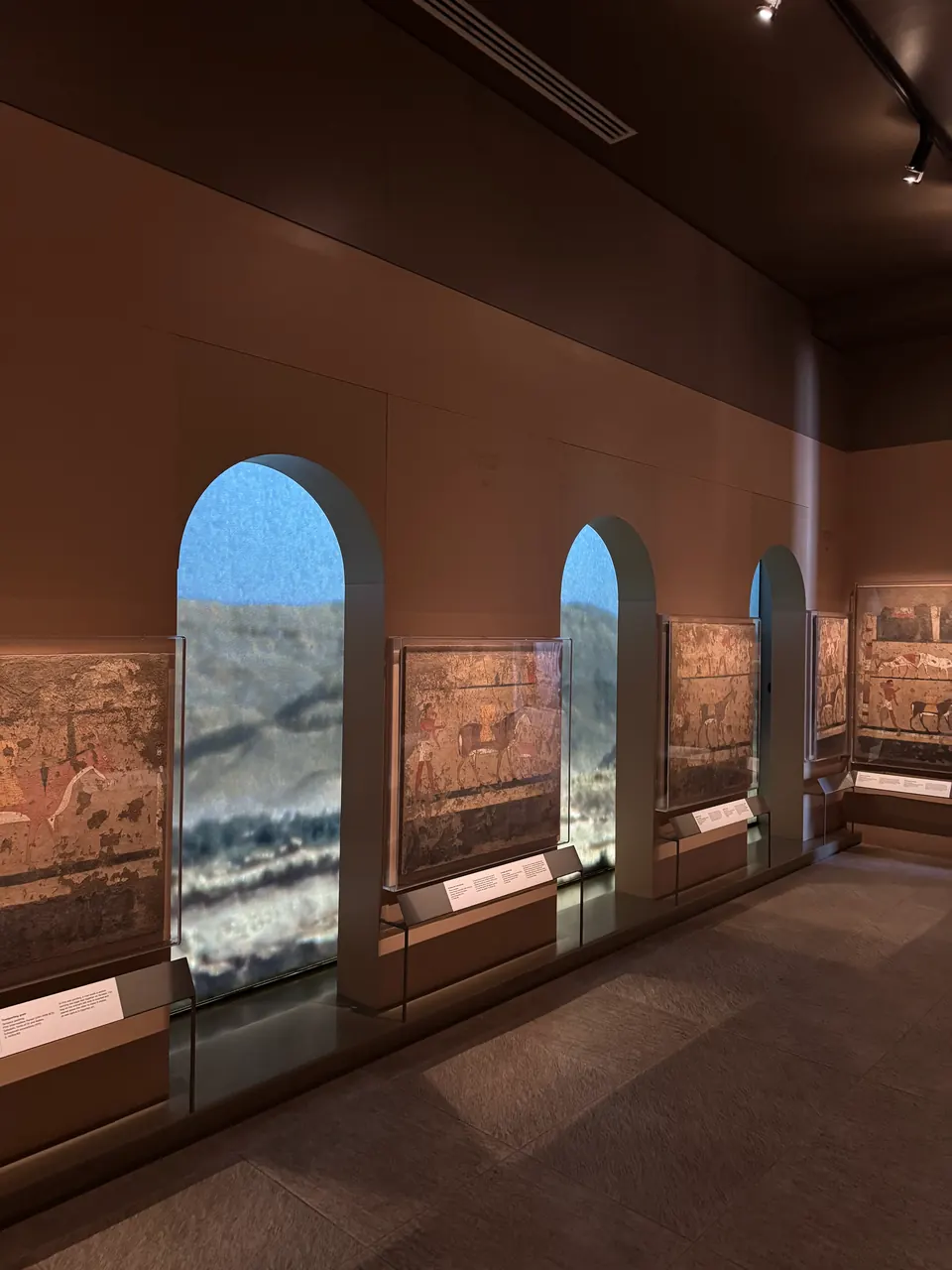
Wall paintings under glass
Wall paintings under glass in a dimly lit room, between arched recesses with an image of a desert landscape; on the panels, figures with animals can be made out, among them what look like donkeys.
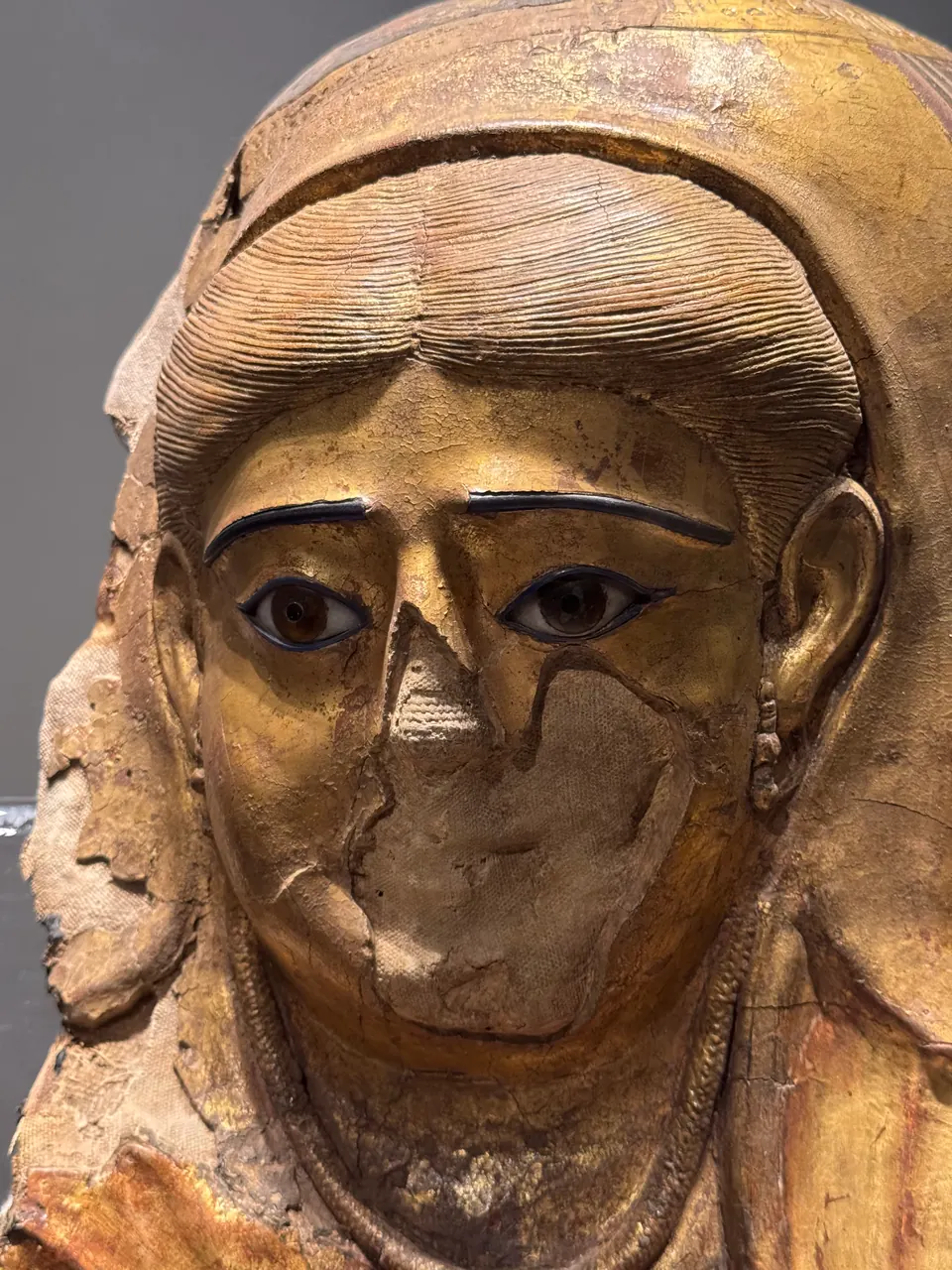
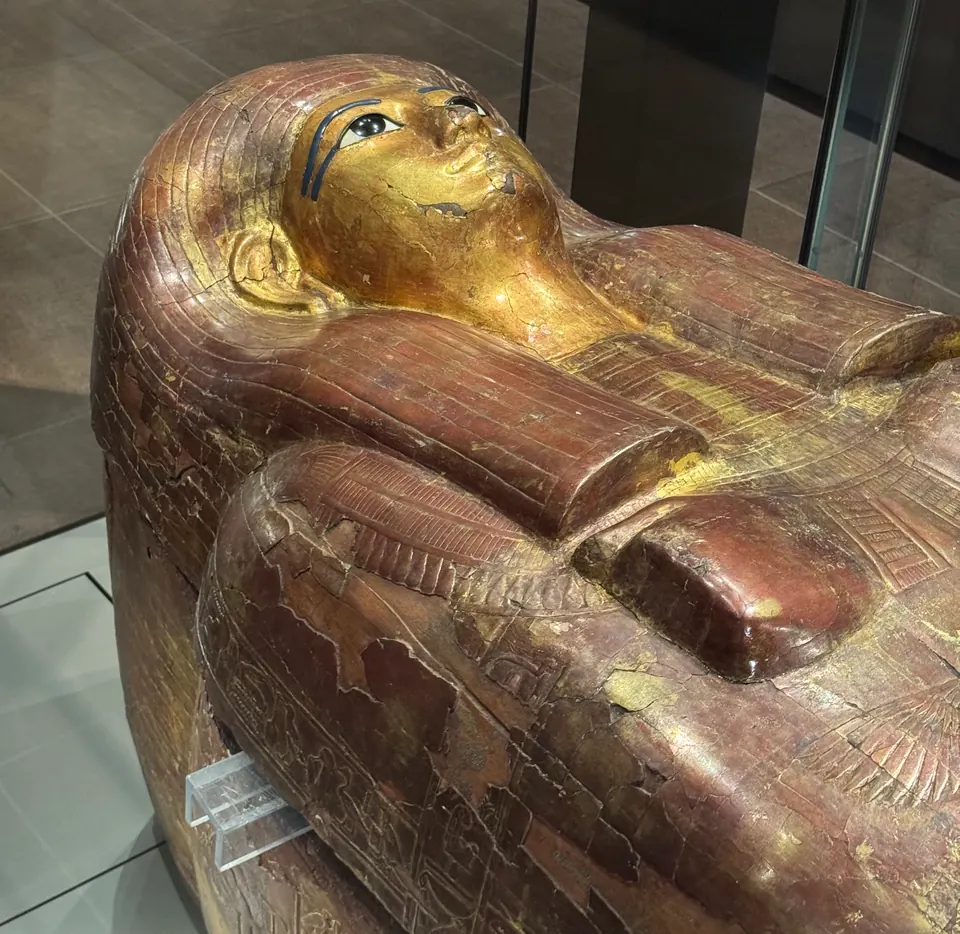
Gilded faces: a mask and a coffin lid
This gilded mask has its hair in fine locks, inlaid brown eyes, dark eyebrows, an earring and a braided necklace; the nose, the mouth and one cheek have lost their gilding and reveal the textile.
Separately, a red-brown coffin lid, with a gilded face and blue eyebrows, seen from above.
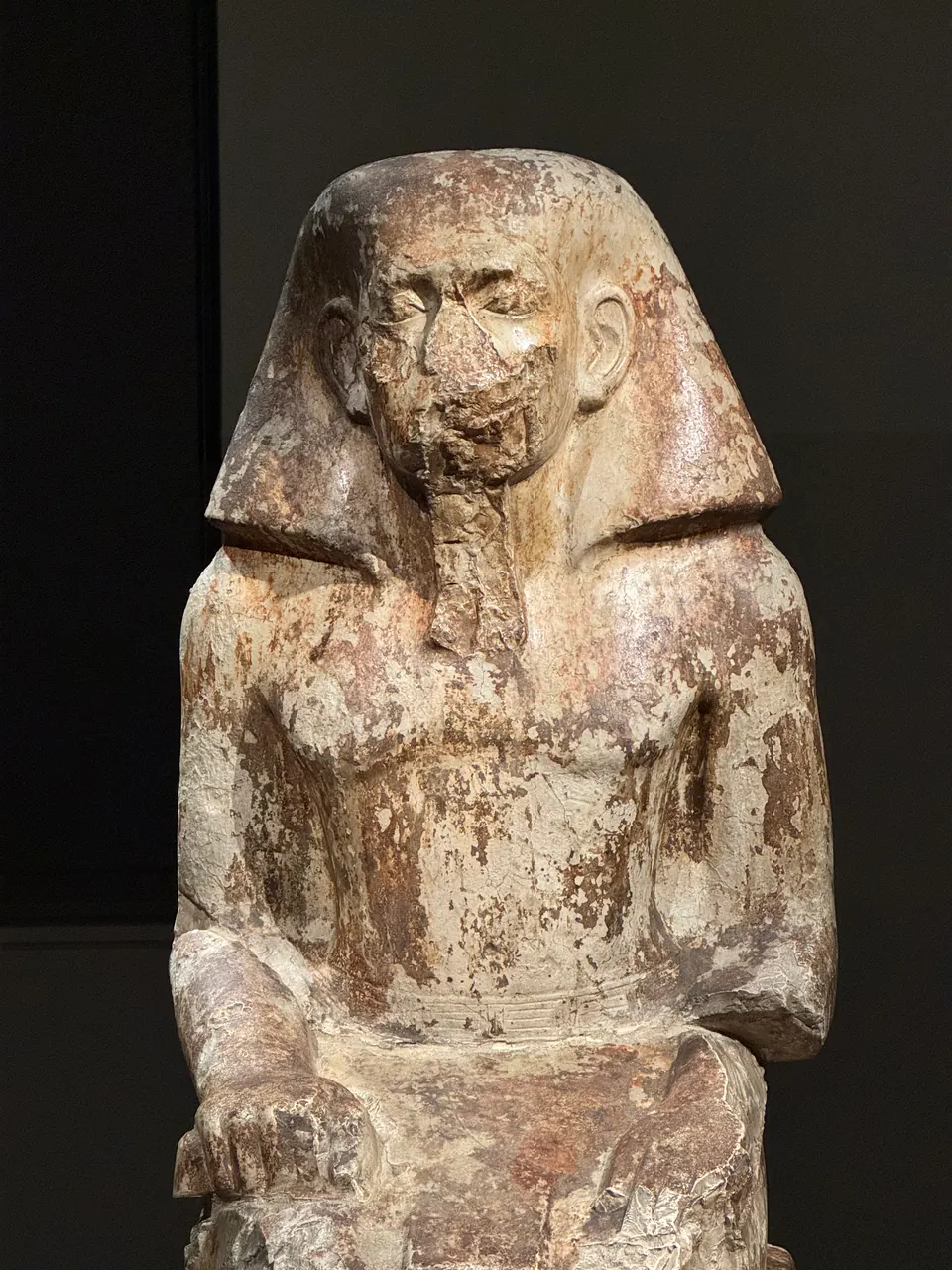
A seated statue in pale stone
Close-up against a black background: long wig, damaged face (the nose and the mouth are missing), what looks like a false beard and a hand resting on the knee.
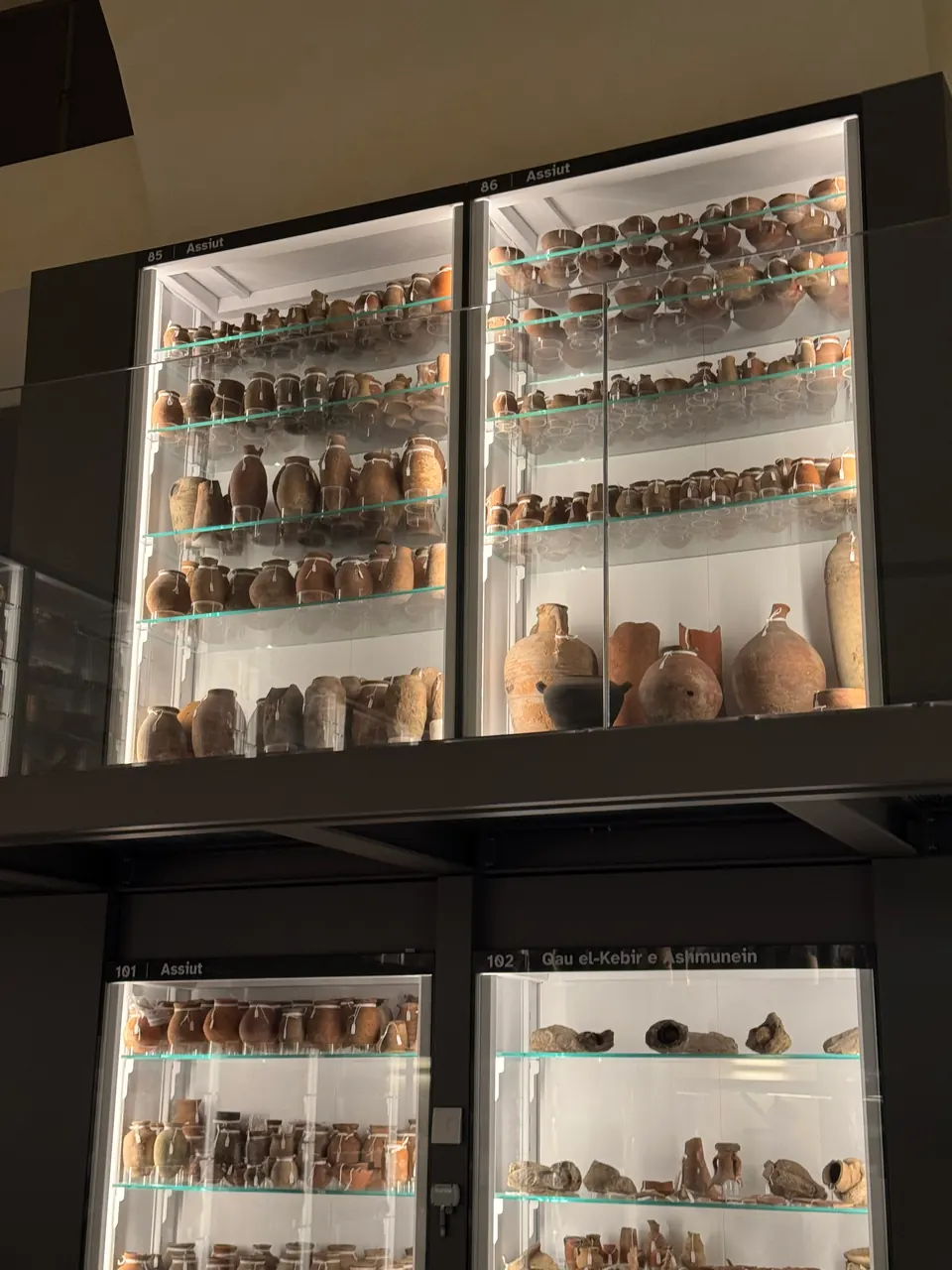
Pottery display cases by site
Two levels of display cases with vessels and tied paper labels; the signs give the site (‘85 Assiut’, ‘102 Qau el-Kebir e Ashmunein’).
Photography at the Egizio: rules and use of photos
What the museum allows. According to its FAQ, photography and video recording are allowed without flash and without professional equipment (it mentions the tripod). The regulations ban flashes and other artificial lights and require prior authorisation for professional sessions: if in doubt, ask info@museoegizio.it.
Use of photos. The regulations prohibit promotional or paid activities in the museum, but neither they nor the FAQ address the later use of a visitor’s photos: to sell or promote photos, ask first.
What to know before you go
Backpacks. The cloakroom is suspended because of building works, according to the museum (Turismo Torino still lists it): there are only free lockers for school-type backpacks (details in the frequently asked questions).
Rules. According to the regulations (March 2025): under-14s accompanied by someone over 18; no eating, drinking or smoking; only guide dogs and therapy animals with a certificate; free audio guide on a mobile phone.
Accessibility. According to its accessibility page, there are no architectural barriers, with a lift serving every floor and two free wheelchairs, which cannot be reserved and are requested at the access desk. There is a quiet room on floor 2 and 20 tactile objects reserved for people who are blind or have low vision.
Chapel of Ellesiya. From 23 Nov 2026 it is visited as part of the museum route, according to the ticket portal.
What’s new. From 23 Nov 2026, according to the museum, the hypogeum houses an immersive room on the landscape of the Nile, which the portal’s notice lists among what can be visited.
Frequently asked questions about the Egyptian Museum of Turin
How long does it take to visit the Egyptian Museum of Turin?
Between 2 hours (FAQ) and 2½ hours (portal), according to the museum, which warns that it depends on the visitor.
Can you take photos in the Museo Egizio?
Yes, without flash and without professional equipment. Professional sessions need prior authorisation and, to sell photos, it is best to ask the museum.
Do you need to book tickets for the Egizio?
The museum states that tickets are bought online, for a fixed time, and that it does not sell tickets on its premises; the 2025 regulations allow on-site sales, but it is unwise to count on that.
How much is a ticket and who gets in free?
The full price is €18, with rates of €15, €3 and €1 and a family rate of €36. Free entry applies, among others, to ages 0 to 5, people with disabilities with one companion and Torino+Piemonte Card holders.
Can you take a backpack into the Egyptian Museum of Turin?
Yes, if it is small. With the cloakroom suspended because of building works, small backpacks and bags are allowed and there are free lockers for school-type backpacks, without booking and while stocks last. Suitcases, trolley cases and large backpacks are not accepted, and bags are checked before the access desk. Using a locker beyond the visit or the museum’s opening hours carries a penalty from €20 per locker, according to the regulations.
Is the Museo Egizio worth visiting?
It depends on your interests. The museum describes itself as the oldest in the world devoted entirely to Egypt; it was founded in 1824 with the Drovetti collection and the Schiaparelli and Farina excavations (1903-1937) brought it some 30,000 pieces. Its holdings include papyri, the grave goods of Kha and Merit and the Chapel of Ellesiya.
When it fits into a trip to Turin
It fits better as a planned visit than as a filler activity: fixed time slot, a margin of 15 to 20 minutes, a bag check and 2 to 2½ hours ahead.
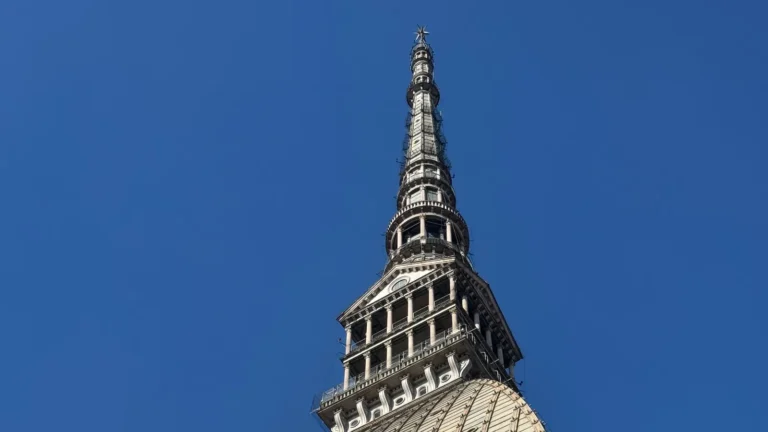
To add the Mole Antonelliana, there are its tickets and the lift.
More destinations in Italy are on the Italy page (in Spanish). If Egypt is what interests you, there is a 10-day photography itinerary and the Egypt notebook. If the museum’s website says something different from this guide, the museum’s website takes precedence.