
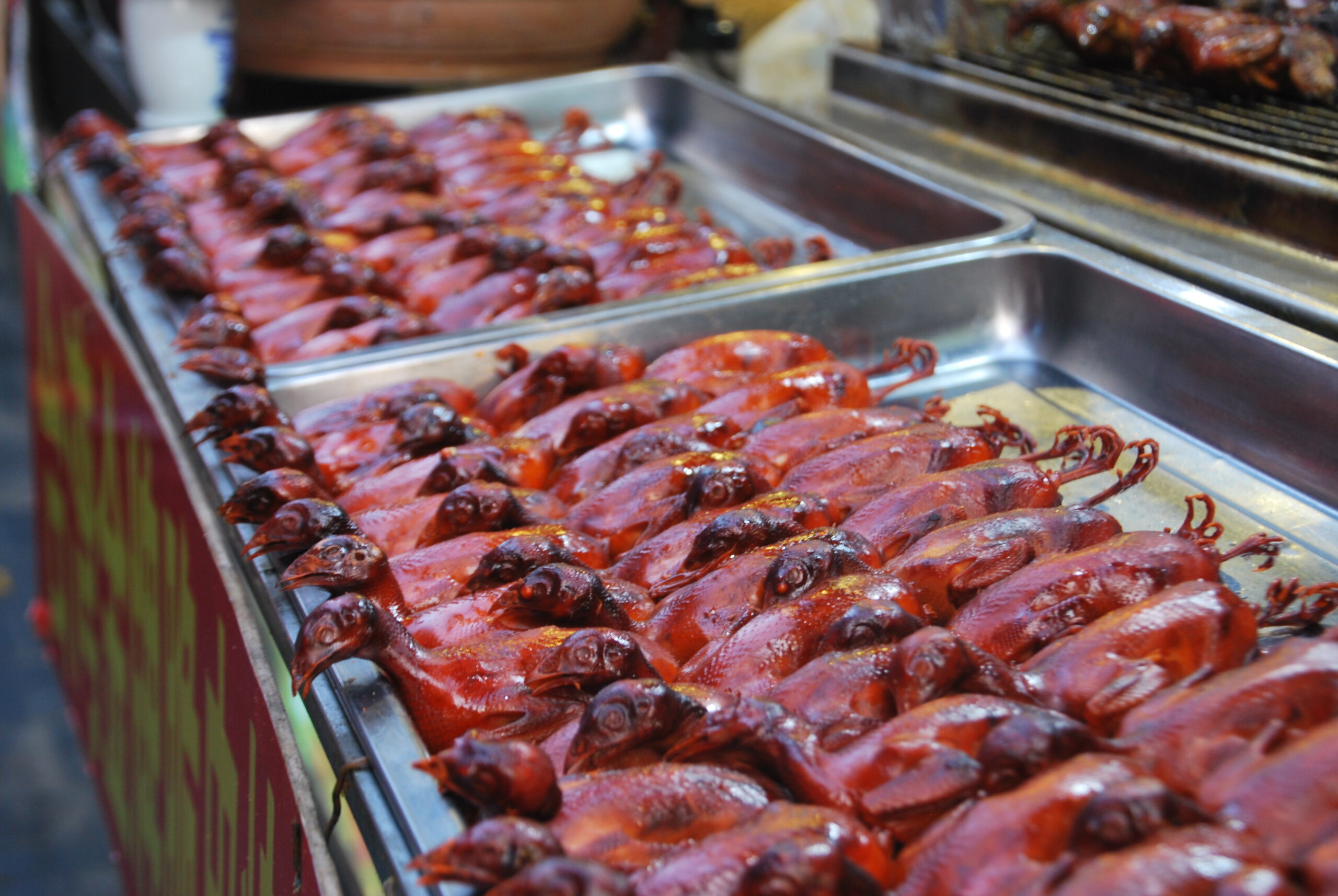
Roujiamo (肉夹馍, ròujiāmó) means, literally, ‘meat sandwich’. It is braised, chopped meat inside a flatbread, a street food from Shaanxi, in north-west China. Wikipedia describes it as the Chinese equivalent of the Western hamburger and of meat sandwiches, although it does not resemble a hamburger: the filling is not moulded; it falls apart.
This is a home version with beef, for four servings: 3 hours of cooking for the meat, best done the day before, and 1 hour 30 minutes for the bread. It includes food-safety guidelines for the meat and the broth, with their official sources.
What roujiamo is, exactly
A flatbread (báijímó, 白吉馍) split in half and filled with braised meat. According to an article from China News Service published on China Daily’s Chinese website (10 Jan 2024), the flour is fermented into a soft dough, which is kneaded, stretched, seared on the griddle and baked. The outside should be crisp; the meat, tender and easy to pull apart. According to Wikipedia, traditional baijimo is baked in a clay oven, although today in many parts of China it is made in a frying pan; this recipe combines frying pan and oven.
- Origin: Shaanxi province. It is often repeated that the dish is about 2,000 years old, but the figure is not documented in the sources consulted: a master craftsman claims it in the China News Service article cited above, and Goldthread (2020) presents it as alleged. Wikipedia attributes the bread to the Qin dynasty (221–206 BC) and the meat to the Zhou (1045–256 BC), but flags that sentence as coming from a source of low reliability. Treat it as tradition, not as corroborated historical fact.
- Recognition: ‘西安肉夹馍’ (Xi’an roujiamo) is listed as an intangible cultural heritage project of Shaanxi province, according to the same China News Service article (10 Jan 2024).
- Filling: pork is the most common; in the Muslim areas of Xi’an it is usually beef, according to Wikipedia, and Goldthread notes that Muslim populations replace pork with beef. This recipe uses beef.
- Chinese name: it is also called 腊汁肉夹馍 (làzhī ròujiāmó), after 腊汁肉, pork cooked in a large pot. According to Chinese Wikipedia, the name alludes to the fat turning as white as wax as it cools.
The spice blend varies from one establishment to another. A note from the China Weather tourism portal (2012) on Xi’an roujiamo lists more than ten, including star anise, cassia, Sichuan pepper and clove, and Goldthread counts more than twenty at one establishment. This home recipe simplifies it to six spices: star anise, Sichuan pepper, fennel, cinnamon, bay leaf and clove.
Ingredients (4 roujiamo)
For the braised meat
- 600 g beef flank or shin
- 1 onion
- 4 garlic cloves
- 1 slice of ginger
- 2 tablespoons vegetable oil
- 2 star anise
- 1 teaspoon Sichuan pepper (花椒)
- 1 teaspoon fennel seeds
- 1 cinnamon stick
- 2 bay leaves
- 3 cloves
- 2 tablespoons dark soy sauce
- 1 tablespoon brown sugar
- 1 tablespoon Shaoxing wine (or dry sherry)
- Hot water: just enough to cover the meat (around 1 litre)
- Salt to taste
For the bread (baijimo 白吉馍)
- 300 g strong flour
- 180 ml lukewarm water
- 1 teaspoon dried baker’s yeast
- 1 pinch of salt
Method, step by step
- Meat: 3 hours of cooking, the day before.
- Resting: overnight in the fridge, at 5 °C or below.
- Bread: 1 hour 30 minutes, on the day of serving.
- Assembly: a few minutes, with the meat reheated.
1. The meat (the day before: 3 hours of cooking and a cold rest)
- Blanch the meat: in a pot of cold water, boil for 5 minutes, discard the foamy water and rinse the meat.
- Fry the aromatics: onion, garlic and ginger in the oil until golden.
- Add the spices: star anise, Sichuan pepper, fennel, cinnamon, clove and bay leaf. Toast for 30 seconds.
- Assemble the braise: add the meat, soy sauce, sugar, wine and enough hot water to cover.
- Cook slowly: 3 hours over low heat, covered and with the broth barely bubbling. The meat should fall apart with a fork; if it still offers resistance, extend the cooking by 30 minutes. Season with salt at the end. With a kitchen thermometer, check that the centre of the meat reaches at least 70 °C. AESAN (Spanish Agency for Food Safety and Nutrition) gives a minimum of 70 °C for at least 2 minutes.
- Cool and rest: turn off the heat. Do not leave the meat and broth at room temperature for more than 2 hours (AESAN and WHO): divide them into closed containers and refrigerate at 5 °C or below until the next day.
2. The bread (1 hour 30 minutes)
- Mix flour + salt + yeast in a bowl.
- Add the water gradually until a soft dough forms. Knead for 8 minutes.
- Leave to prove for 45 minutes, covered, until it has almost doubled in volume.
- Divide into 4 balls. Shape each one into a 10 cm disc.
- Cook in a dry frying pan over medium heat, 3 minutes per side, until the surface is golden with toasted spots.
- Finish the flatbreads in the oven, preheated to 190 °C, for 8 to 10 minutes, until golden and cooked through.
3. Final assembly
- Reheat the meat in its broth until it boils and keep it on a gentle heat for at least 2 minutes (AESAN asks for 70 °C for two minutes for leftovers).
- Take the meat out of the broth and chop it finely with two knives, without mashing it.
- Reduce about 150 ml of broth over high heat until it thickens and mix the meat with 2–3 tablespoons.
- Split the bread in half horizontally, without separating the halves completely.
- Fill with the meat, pressing it down lightly.
- Serve straight away, hot, and eat it by hand.
How to use the leftover broth
The cooking broth can be used as the base of another stew. The China Weather (2012) note on Xi’an roujiamo mentions that the meat is cooked in an aged broth (陈年老汤, chénnián lǎotāng), without saying how many years. WHO guidelines, on the other hand, recommend not storing food for a long time, even in the fridge. So at home it is best to treat the broth like any stew: cool it quickly, keep it refrigerated at 5 °C or below, do not store it for a long time and boil it before using it again.
Summary of the WHO and AESAN guidelines: cool quickly, refrigerate at 5 °C or below, do not store food for a long time and reheat it to 70 °C.
If you order it in Xi’an
This guide does not recommend specific places, because addresses, opening hours and prices change frequently. Before ordering, three useful points.
- Filling: pork is the most common; in the Muslim neighbourhoods of Xi’an it is usually beef (Wikipedia).
- Pairing: in Shaanxi it is often sold with liangpi and with the Ice Peak soft drink (Wikipedia).
- Variants: roujiamo is found, with regional modifications, all over China and not only in Shaanxi (Wikipedia).
What to serve with it
- Liangpi (凉皮) — cold noodles made from wheat or rice flour, a Xi’an speciality, with ingredients such as chilli, vinegar and sesame (Wikipedia). In Shaanxi it usually accompanies roujiamo.
- Suan mei tang (酸梅汤) — a cold, sweet-and-sour drink made from smoked plum, a common summer drink in China (Wikipedia).
- Tea or herbal tea — a hot drink without sugar, to each person’s taste.
Practical information (official sources, checked on 19 Oct 2026)
- Meat and leftovers: according to the Agencia Española de Seguridad Alimentaria y Nutrición (AESAN), the centre of the meat must reach a minimum of 70 °C for at least 2 minutes; leftovers are refrigerated as soon as possible and must not stay at room temperature for more than 2 hours; the fridge should be at 5 °C at most; and leftovers are reheated to 70 °C for two minutes.
- Broths and stews: according to the Five Keys to Safer Food poster of the World Health Organization, soups and stews are boiled to make sure they reach 70 °C, cooked food is not left at room temperature for more than 2 hours and food is not stored for a long time, even in the fridge.
- Entry to China from Spain: according to the Ministerio de Asuntos Exteriores (Spain’s Ministry of Foreign Affairs), holders of an ordinary Spanish passport are exempt from a visa for stays of up to 30 days (tourism, business, family or exchange visits, and transit), and this arrangement has been extended until 31 Dec 2026. No minimum passport validity is required to enter mainland China. Anyone staying in a private home must register at the nearest police station within 24 hours. The Ministry gives 12 Jun 2026 as the last update; if you travel after 31 Dec 2026, check the page again.
Published on Bidaiatzen. Instagram: @vidaiatzen.
