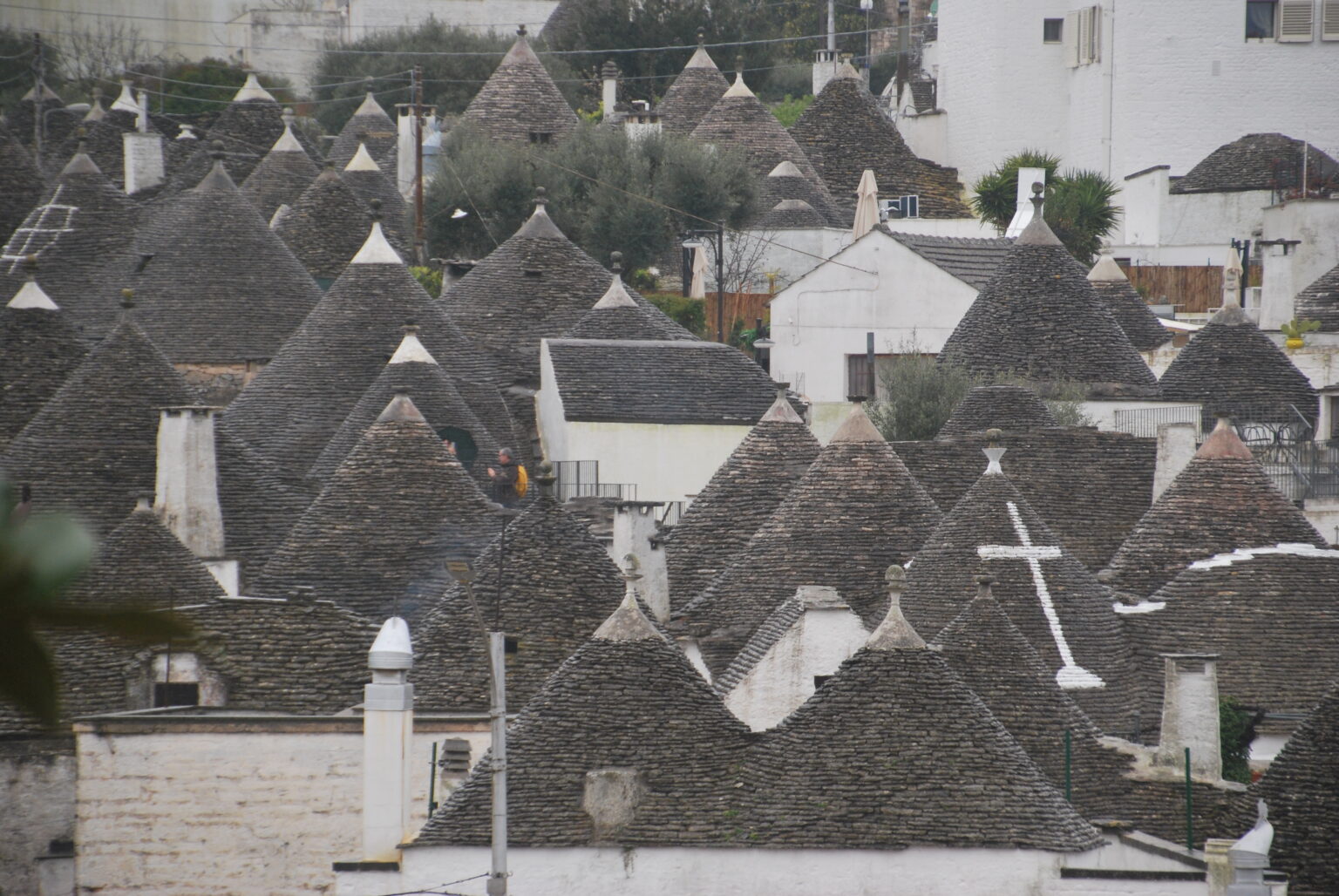
Alberobello Trulli: History, What to See and Tickets
Alberobello has more than 1,500 trulli, a UNESCO World Heritage Site since 1996, in two districts you can walk around, and the two-storey Trullo Sovrano costs €2.50 to visit.
By Ander BilbaoOwn photosPublished 12 min read
Alberobello in short
- What to see
- Two trulli districts and four buildings, all on foot
- Trullo Sovrano
- €2.50; open every day with no booking needed, according to the Comune
- Comune museums
- Casa Pezzolla and Casa d’Amore: joint ticket, price not published
- Closed
- Those two museums, on Wednesdays from November to May
- From Bari
- FS Sud Est bus or train; the bus leaves from Bari Centrale
Data checked on 15 Nov 2026 with: the Trullo Sovrano website (price), the Comune di Alberobello (hours, closures, booking and joint ticket), Trenitalia (bus from Bari Centrale), Italia.it (on foot) and UNESCO (number of trulli and 1996 inscription). None of the official sources consulted gives a visit length.
Photos by the author, taken with a Nikon D60 and a Tamron 18-270 mm lens on 2 April 2026, according to the EXIF data. Prices and opening hours come from each site’s official website, with the source under each entry; where two official sources disagree, the entry says so. About me
| Site | Price | Closed |
|---|---|---|
| 01Rione Monti | Free | No set hours |
| 02Rione Aia Piccola | Free | No set hours |
| 03Trullo Sovrano | €2.50 | Open daily (Comune, 2024) |
| 04Church of Sant’Antonio | No official data | No data |
| 05Museo del Territorio (Casa Pezzolla) | Joint ticket | Wed, Nov–May |
| 06Casa d’Amore | Joint or single ticket | Wed, Nov–May |
| ·The tax legend and what the sources say | ||
| ·How a trullo is built | ||
| ·The symbols painted in limewash | ||
| ·Photography: when and how | ||
| ·Before you plan | ||
| ·Getting there and entry documents | ||
| ·Where to stay: how to choose accommodation | ||
| ·Combining it with the Itria Valley | ||
| ·Sources | ||
Rione Monti: more than a thousand trulli on fifteen streets
The district covers 6 hectares on the slope of the hill south of the town. ICOMOS counted 1,030 trulli there in 1996, and the Comune now speaks of more than a thousand, spread across fifteen streets.
Many of the houses are now shops. The oldest, according to the Comune, are on Via Monte Nero, Via Monte Pasubio, Via Monte San Michele and Via Monte Sabotino.
- Price
- Free: these are public streets.
- Hours
- No published hours.
- Getting there
- Enter from Via Monte San Michele.
Sources: Comune di Alberobello (location, more than a thousand trulli, streets and access) and ICOMOS (1996) (6 hectares and 1,030 trulli) · checked on 15 Nov 2026.
Rione Aia Piccola: the district without shops
ICOMOS counted 590 trulli here in 1996 and found it less homogeneous than Monti. According to the Comune, it is the only area untouched by commercial activity, and Italia.it counts about 400 trulli in residential use. It is best treated as a district where people live.
- Price
- Free: these are public streets.
- Hours
- No published hours.
- Getting there
- Enter from Via Giuseppe Verdi.
Sources: Comune di Alberobello, ICOMOS (1996) and Italia.it · checked on 15 Nov 2026.
Trullo Sovrano: a two-storey trullo open as a house museum
ICOMOS describes it as a late two-storey trullo and recommended including it in the inscribed area. According to the Comune, it marks the move to building with mortar, is privately owned and is used as an exhibition space; its website presents it as a house museum.
- Price
- €2.50, single ticket.
- Hours
- November–March: 10:00–12:45 and 15:30–18:00. April–October: 10:00–12:45 and 15:30–18:30. According to the Comune (2024), it opens all week and needs no booking.
- Getting there
- Piazza Sacramento 10/11. Phone: +39 080 432 6030.
Sources: Trullo Sovrano website and Comune · checked on 15 Nov 2026. Note: the Comune’s page (27 May 2024) has mornings until 13:15 and April–October afternoons until 19:00; confirm by phone.
Church of Sant’Antonio: a trullo-shaped church
It is dedicated to Saint Anthony of Padua. According to Italia.it, it was built in 14 months, in 1927, and was substantially altered in the 1960s.
- Price
- No official data.
- Hours
- No official data.
- Getting there
- At the top of Via Monte San Michele.
Source: Italia.it · checked on 15 Nov 2026. The Comune has no page for the church, so price and hours have no official source.
Museo del Territorio (Casa Pezzolla): 15 interconnected trulli
Fifteen interconnected trulli. The Comune bought them in 1986 and restored them between 1993 and 1997.
The tour covers the area’s farm work and recreates the typical furnishings of a trullo.
- Price
- Included in the Polo Museale joint ticket, with Casa d’Amore; price not published.
- Hours
- June–October: daily, 10:00–18:00. November–February: 10:00–16:00. March–May: 10:00–13:30 and 14:00–17:30. Closed on Wednesdays from November to May.
- Getting there
- Piazza XXVII Maggio. Phone: +39 080 214 7389.
Sources: the Comune’s pages for the museum (9 Oct 2026) and Casa d’Amore (joint ticket) · checked on 15 Nov 2026. Note: Italia.it says entry is free, but the Comune includes it in the paid joint ticket; check first.
Casa d’Amore: the first house officially built with mortar
According to a tradition recorded by the Comune, work began on 22 June 1797, the day the first mayor was elected.
Today it houses a centre on dry-stone techniques and the UNESCO heritage of the trulli.
- Price
- Joint ticket with Casa Pezzolla (ticket office or Vivaticket) or a Casa d’Amore-only ticket (ticket office); prices not published.
- Hours
- November–February: 10:00–14:00. March–May: 10:00–13:30 and 14:00–17:30. June–October: daily, 10:00–18:00. Closed on Wednesdays from November to May.
- Getting there
- Piazza Re Ferdinando IV di Borbone 3.
Source: the Comune’s page (8 Oct 2026; calendar to October 2027) · checked on 15 Nov 2026.
The tax legend and what the sources say
The popular version says that the Counts of Conversano, lords of the area, had the settlers build in dry stone. That way the houses looked temporary and could be taken down quickly if the Kingdom of Naples sent an inspection.
The aim would have been to dodge the tax that, according to Italia.it, the kingdom’s law levied on every new village. The portal itself presents this as a hypothesis (“according to some studies”), not as a fact.
ICOMOS, the body that advises UNESCO on cultural heritage, records the tradition with some nuance in the evaluation it submitted in October 1996 for the site’s inscription on the World Heritage List. According to the tradition, dry stone was imposed on the settlers so that houses could be dismantled quickly: first, to dispossess reluctant householders easily; later, to avoid the tax on new settlements.
ICOMOS adds that this is known to have happened in 1644, to thwart the tax inspectors sent by the King of Naples. But it concludes that, on historical and comparative analysis, the technique was no more than a minimal physical response to local conditions, later exploited for fiscal or punitive purposes.
In short: there is one specific episode, in 1644, but ICOMOS sees the tax as a later use of the technique, not its origin. UNESCO adds that trulli were usually temporary shelters and storehouses in the countryside, or permanent homes for small landowners and day labourers, and that dry stone is a tradition several thousand years old in the Mediterranean.
Timeline according to UNESCO, ICOMOS and the Comune:
- Mid-fourteenth century: ICOMOS records that the present settlement is usually dated here, when Robert of Anjou, Prince of Taranto, grants the area to the first Count of Conversano as a reward for his services in the Crusades. Italia.it places the birth of the town at the end of that century, and UNESCO records scattered rural settlements around the year 1000.
- Mid-sixteenth century: the Rione Monti had around forty trulli.
- 1620: Count Gian Girolamo Guercio orders the building of a bakery, a mill and an inn, and the settlement begins to grow.
- 1797: Ferdinand IV of Bourbon, King of Naples, grants Alberobello the rank of royal city and ends feudal rule. The name Alberobello comes from the medieval Latin name of the area, silva arboris belli. From then on, the building of new trulli declines. According to the Comune, Casa d’Amore, from that year, is the first house officially built with mortar.
- 1843: the urban and rural police regulations ban dry-stone building in the town, with the exception of the Rione Monti, inhabited by poor people, according to the Comune’s page.
How a trullo is built
UNESCO describes the trulli as remarkable examples of dry-stone construction (without mortar) using a prehistoric technique that is still used in the region. ICOMOS places the closest precedents for their corbelled slab roofs in the tholos tombs of Mycenaean Greece and the nuraghi of Sardinia. These are the main elements:
- Walls: limestone without mortar, in a double skin with rubble infill, built directly on the rock and whitewashed. A fireplace and niches are set into the thick walls (UNESCO).
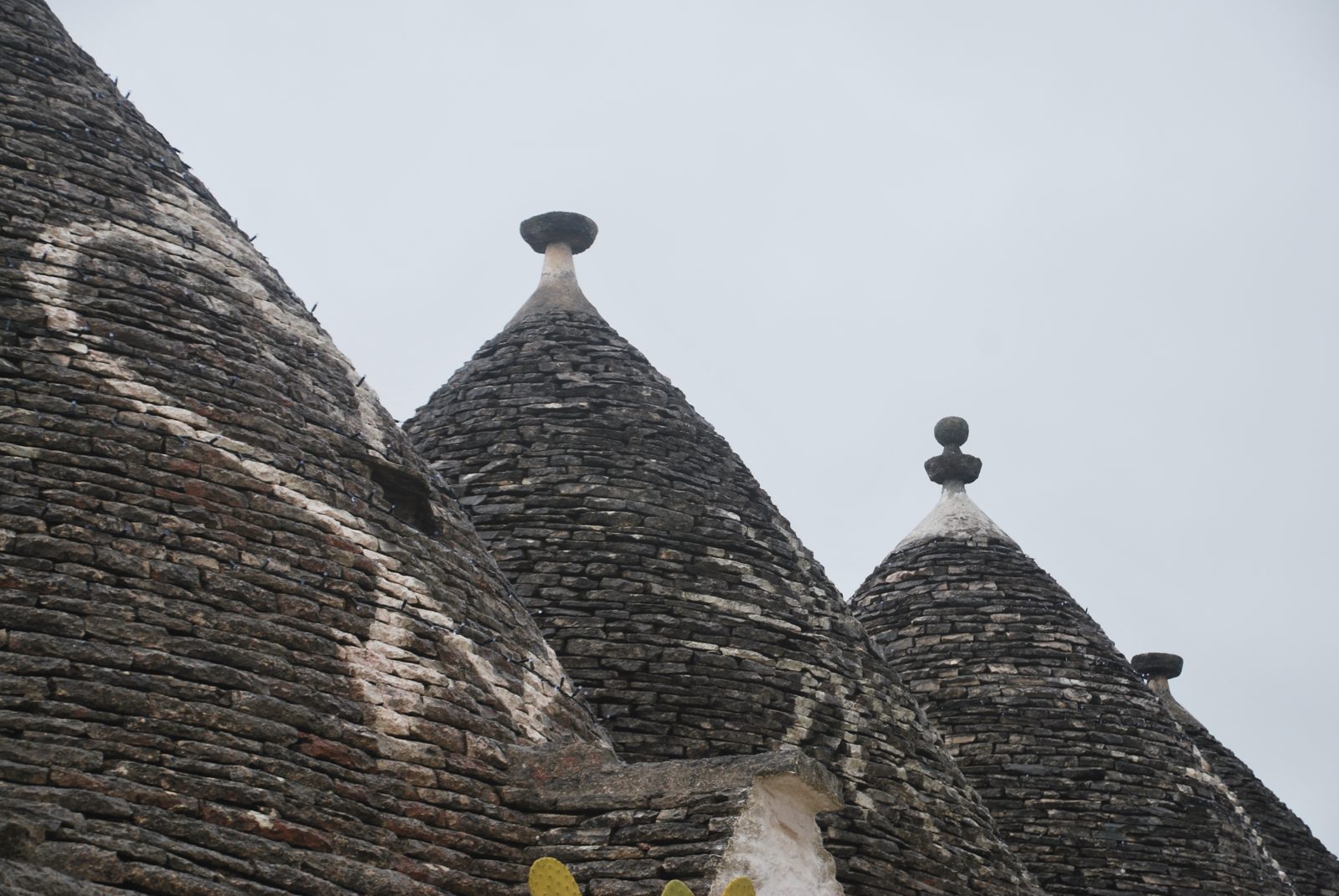
- Roof: double. Inside, a dome of wedge-shaped stones; outside, a cone of limestone slabs called chianche or chiancarelle, 5 to 7 cm thick according to ICOMOS. Rainwater runs down the eaves into a cistern beneath the house.
- Pinnacle: a decorative finial at the tip of the roof. UNESCO states that it serves to ward off evil influences or bad luck.
The symbols painted in limewash
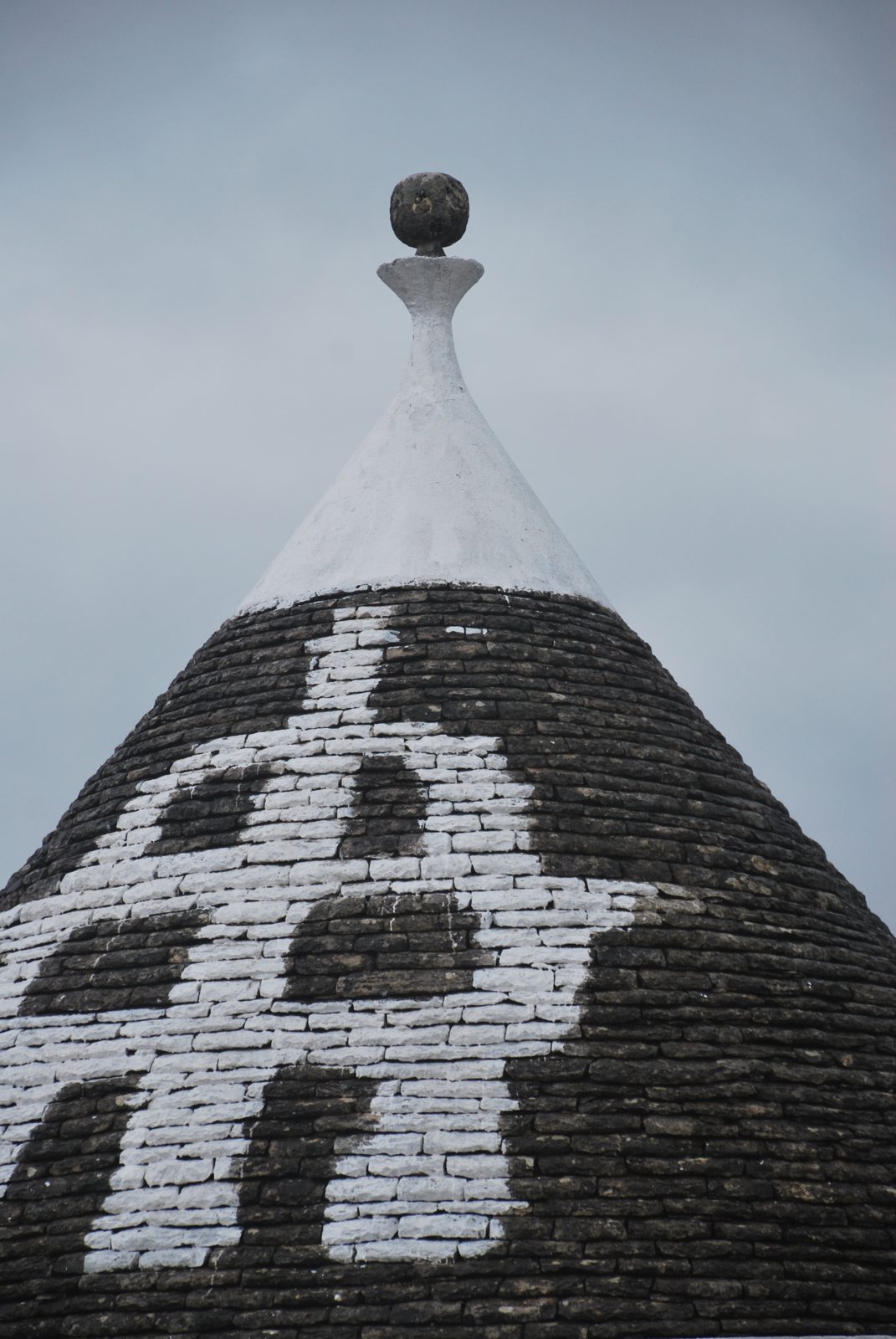
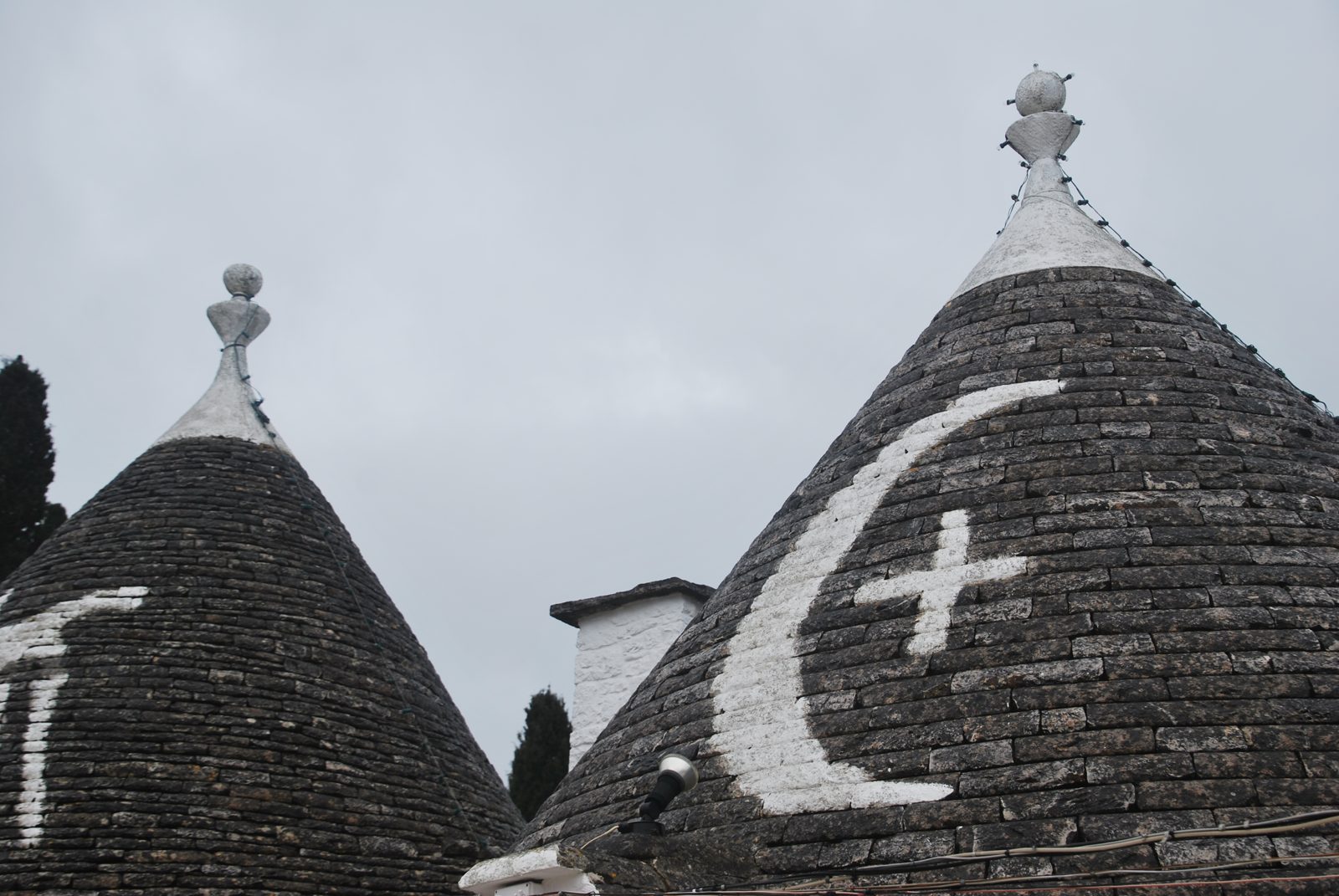
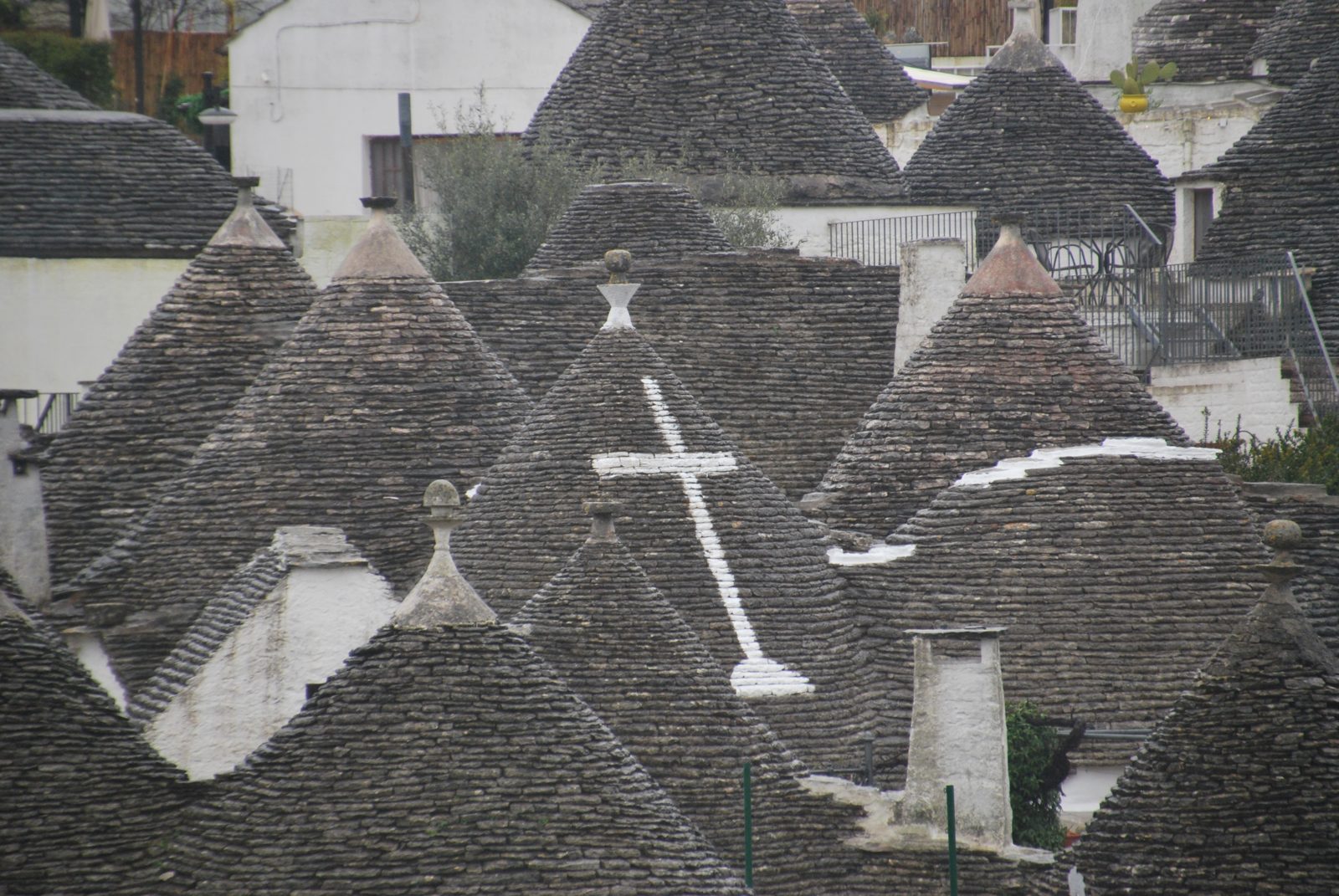
According to ICOMOS, the stone roofs are not painted and over time grow moss and lichens, but they sometimes carry symbols drawn in limewash. The lists with a fixed meaning for each figure that circulate on the internet do not appear in the official sources consulted, so they cannot be given as documented facts.
- Where: on the grey slabs of the roof, in white limewash.
- What they are: marks of a mythological or religious nature, according to UNESCO.
- What is not known: the specific meaning of each symbol; neither UNESCO nor ICOMOS gives details.
Photography: when and how
- Belvedere Santa Lucia (Piazza Giangirolamo): a viewpoint over the trulli of the Rione Monti. The Comune says it can be reached on foot after a short climb or by car to the vicinity, and Italia.it recommends going at sunset.
- Light: early in the morning and late in the afternoon the light is lower and softer on the stone roofs; around midday the shadows are harsh (a general photography rule of thumb, not a local fact).
- Lenses: a wide-angle lens helps in the narrow streets and a short telephoto on the pinnacles and the limewash marks (generic suggestion).
- Respect: ICOMOS states that the trulli are mostly privately owned. In Aia Piccola and at any inhabited trullo, ask permission before photographing people, courtyards or interiors.
Before you plan
- Wednesdays
- From November to May, Casa Pezzolla and Casa d’Amore are closed; the Comune says the Trullo Sovrano opens all week.
- Midday
- The Trullo Sovrano closes from 12:45 to 15:30, according to its website.
- Tickets
- One joint ticket covers Casa Pezzolla and Casa d’Amore; the Trullo Sovrano is separate (€2.50).
- Sunset
- The time Italia.it recommends for the Belvedere Santa Lucia.
A summary of entries 03, 05 and 06 and of the photography section.
Getting there and entry documents
From Bari by public transport
- The FS Sud Est bus leaves from the FS Park bus terminal at Bari Centrale, on Via Capruzzi.
- It stops at Turi and Putignano before reaching Alberobello.
- Arriving in Bari on a Trenitalia regional train? Buy train and bus together on Trenitalia, with Alberobello as the destination.
- There is also an FS Sud Est train: check its timetables and service changes before you set off.
Source: Trenitalia, “Trulli Link” · checked on 15 Nov 2026. That page gives no timetable, season or journey time; train and bus times are on the FS Sud Est website.
By car, motorbike or bicycle
- Besides the train, the Comune lists car, motorbike and bicycle; its reference address is the Strada Statale 172 dei Trulli.
- If you are driving, ask the Municipal Police about access to the centre and parking first: +39 080 403 6222.
Source: Comune di Alberobello, page updated on 2 Oct 2026 · checked on 15 Nov 2026. Comune switchboard: +39 080 403 6211.
Entry documents
Entry rules depend on your nationality. EU citizens can check Your Europe; UK travellers, the GOV.UK page for Italy; everyone else, their own government’s travel advice.
For Spanish citizens, Spain’s Ministry of Foreign Affairs says you need a valid national ID card (DNI) or passport (a passport is compulsory on flights arriving from outside the EU); no visa is needed and no vaccinations are required. It advises carrying both documents and warns that Italy is applying border checks to Spanish citizens arriving by sea or by air.
Source: Ministerio de Asuntos Exteriores (Spain), recommendations in force on 15 Nov 2026 · checked on 15 Nov 2026. Your Europe and GOV.UK checked on 15 Nov 2026.
Where to stay: how to choose accommodation
In 1996, ICOMOS put the share of trulli in commercial use, mostly linked to tourism, at 30%, and the 2006 periodic report that Italy sent to UNESCO repeats that figure. This guide does not recommend specific places or give prices: they change with the date and no official source publishes them.
Three criteria for choosing:
- Administrative registration: according to the Comune di Alberobello (notice of 18 Nov 2025), Puglia’s regional law 15/2025 requires tourist rentals to file a notification (CIA or SCIA) with the municipal one-stop shop (SUAP) and to take out civil liability insurance covering guests. Ask the host to confirm that they meet both requirements.
- Access and parking: ask how to get there with luggage and where to park. For the traffic rules in the centre, check with the Municipal Police (+39 080 403 6222, according to the Comune).
- Tourism pressure: UNESCO includes tourism pressure among the threats to the site in its 2006 periodic report, and the 2014 one rates its impact as significant and continuing. As a general rule, book with some lead time and compare the cancellation conditions.
Combining it with the Itria Valley
- Locorotondo: a town with a circular layout, white houses with pitched roofs (cummerse) and an Orange Flag from the Touring Club Italiano, according to Italia.it.
- Martina Franca: known for its Baroque architecture and, every July, for the Itria Valley Festival, according to Italia.it.
- Cisternino: known for the fornelli, taverns where meat is cooked over hot coals at any hour, according to Italia.it.
- Ostuni: the “White City”; its historic centre used to be painted entirely white and today only partly is, according to Italia.it.
Italia.it suggests a four-day driving route in five stages through the valley: Martina Franca, Locorotondo, Alberobello, the Castellana Caves and Cisternino. Journey times between towns vary with the road and the time of day; work them out in your maps app.
To take Puglia home to your kitchen, there is our orecchiette with cime di rapa recipe. And if your trip continues into Campania, see Naples and Pompeii in 4 days.
Sources
- Trullo Sovrano · official (monument website) · price and hours · checked on 15 Nov 2026
- Comune: Trullo Sovrano · official · opening days, booking, storeys, exhibitions and 2024 hours · checked on 15 Nov 2026
- Comune: Museo del Territorio · official · hours, phone and history · checked on 15 Nov 2026
- Comune: Casa d’Amore · official · hours, tickets, address and history · checked on 15 Nov 2026
- Comune: Rione Monti · official · location, trulli, streets, access and the 1843 rule · checked on 15 Nov 2026
- Comune: Rione Aia Piccola · official · residential use and access · checked on 15 Nov 2026
- Comune: Belvedere Santa Lucia · official · address and access · checked on 15 Nov 2026
- Comune: Alberobello · official · arrival, Municipal Police and switchboard · checked on 15 Nov 2026
- Comune: regional law 15/2025 · official · tourist rentals · checked on 15 Nov 2026
- Trenitalia: Trulli Link · official (operator) · bus from Bari Centrale · checked on 15 Nov 2026
- FS Sud Est · official (operator) · train and bus timetables; check them before you travel
- Italia.it: the trulli of Alberobello · official (tourism portal) · on foot, Sant’Antonio, Belvedere, Casa Pezzolla, legend and Aia Piccola’s residential trulli · checked on 15 Nov 2026
- Italia.it: Itria Valley route, Itria Valley and Cisternino · official (tourism portal) · towns of the valley · checked on 19 Oct 2026
- UNESCO Office of Italy’s Ministry of Culture (original entry at whc.unesco.org) · official · number of trulli, 1996, technique and symbols · checked on 15 Nov 2026
- ICOMOS: evaluation of property No. 787 (October 1996) · official (UNESCO adviser) · district figures, 1644, slabs and commercial use · checked on 15 Nov 2026
- Periodic reports to UNESCO, 2006 and 2014 · official · commercial use and tourism pressure · checked on 19 Oct 2026
- Ministerio de Asuntos Exteriores (Spain) · official · documents for Spanish citizens · checked on 15 Nov 2026
- Your Europe · official (EU) · documents for EU citizens · checked on 15 Nov 2026
- GOV.UK: Italy entry requirements · official (UK) · UK travellers · checked on 15 Nov 2026
More travel photography on Instagram: @vidaiatzen.
