
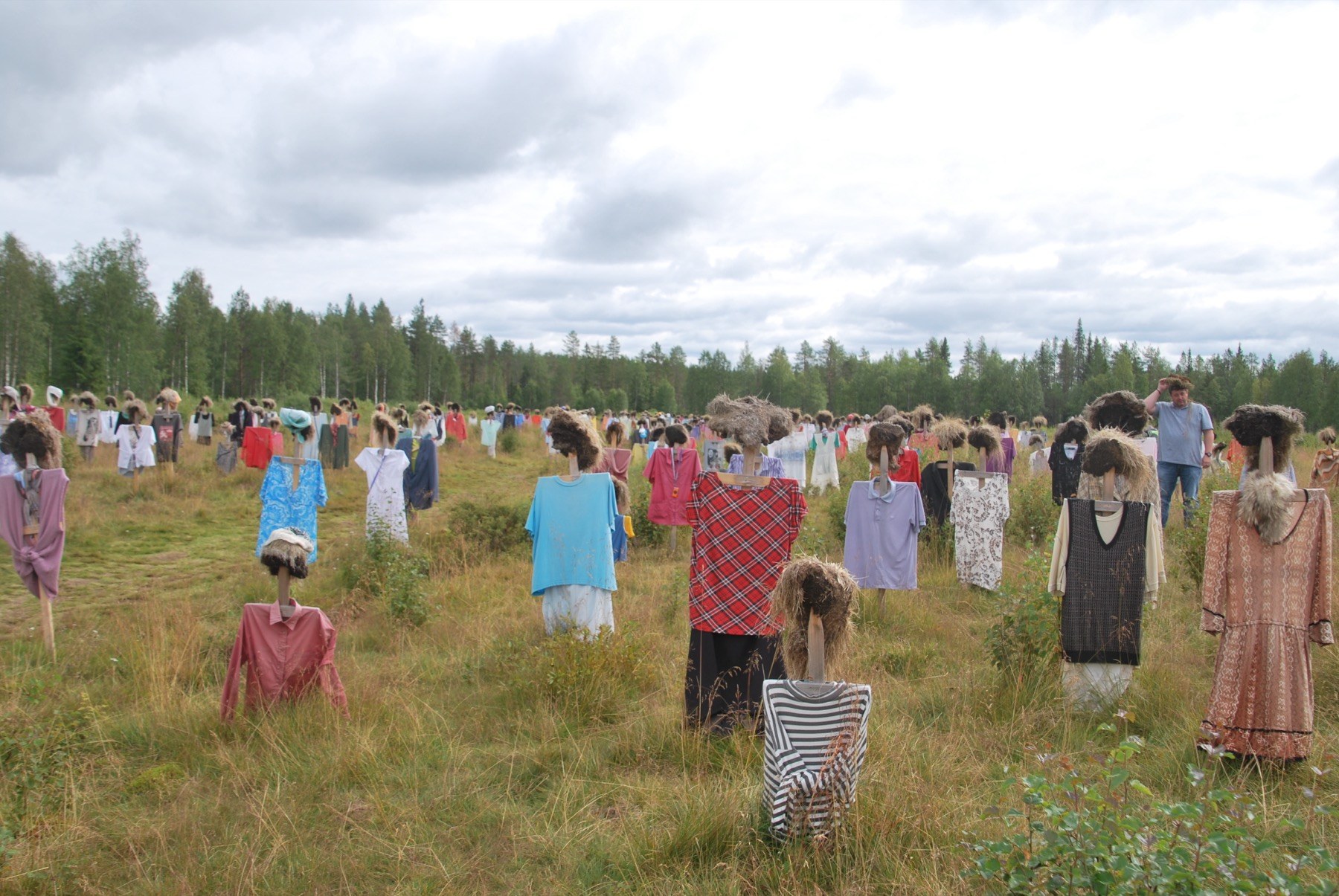
You stop the car in the middle of Finland. There, in a field by Road 5, stand around a thousand silent human figures. Wooden bodies dressed in real clothes, heads of dried turf, hair of dried grass. They face the road, they face the wind, they face nothing in particular.
The piece is called Hiljainen Kansa — The Silent People — and it has stood in this Suomussalmi meadow since 1994. The artist is Reijo Kela, a Finnish performance artist. He created the figures in 1988 with the people of the village. Each figure was dressed by a different family, with old clothes that nobody used anymore. The clothing is replaced every couple of years to survive the Arctic winters.
What does it mean
Reijo Kela has never given an official interpretation. Each visitor decides what they see.
Some read it as a tribute to the dead of the Gulag, silent under Stalin’s labour camps. Others see the fallen of the Winter War — Soviet and Finnish soldiers lost in the 1939-40 conflict that defined this border region. Others see the disappeared — anyone who vanished without a grave, without a name. And some, simply, see themselves: quiet, lined up, waiting, facing the road.
The silence here is not absence. It is a choice.
Where it is
Hiljainen Kansa stands in the village of Suomussalmi, in the Kainuu region of north-eastern Finland. It is roughly 600 km north of Helsinki and 200 km from the Russian border. The figures occupy a meadow in Käpylä, visible from Road 5.
- Coordinates: 64.880° N, 28.873° E
- Access: free, 24 hours, all year round
- Closest town: Suomussalmi (5 minutes by car)
- Closest international airport: Kuusamo (90 km) or Oulu (170 km)
How to visit
There is no entry. There is no panel. There is no audioguide. You park on the verge, you walk a hundred metres into the field, and the figures begin. The first time you see them they look like a crowd. Then you walk among them and they become individuals — each one with its own jacket, its own scarf, its own posture toward the road.
The best time to visit is at sunrise or sunset, when low fog often covers the field and the figures emerge from the mist. In winter the meadow is buried under a metre of snow and only the heads remain visible. In summer, dragonflies cross between the figures.
What to combine it with
Hiljainen Kansa is a 30-minute experience. The drive to Suomussalmi is long; pair it with:
- Hossa National Park (40 km north): hiking trails with prehistoric rock paintings.
- Raate road and the Winter War open-air museum: 30 km from the figures, where the Soviet 44th Division was destroyed in 1939-40.
- Vuokatti: a small Finnish ski resort 90 km south, popular with cross-country skiers.
A note on ethics
The figures are not a museum. They are a piece of community art that the residents of Suomussalmi maintain themselves. Walk among them, photograph them, sit silently with them — but do not climb on them, do not move them, do not rearrange the scarves. They have stood here for thirty years exactly because no one has asked them to perform.
If you want to know more, the village’s tourism office can show you a small documentary about Reijo Kela’s work and the original 1988 installation.
Bidaiatzen visited Hiljainen Kansa in May 2026 and brought back about 200 photographs. The selection is in this gallery and on Instagram @vidaiatzen.
